
Yahia AbazaSenior Product Manager
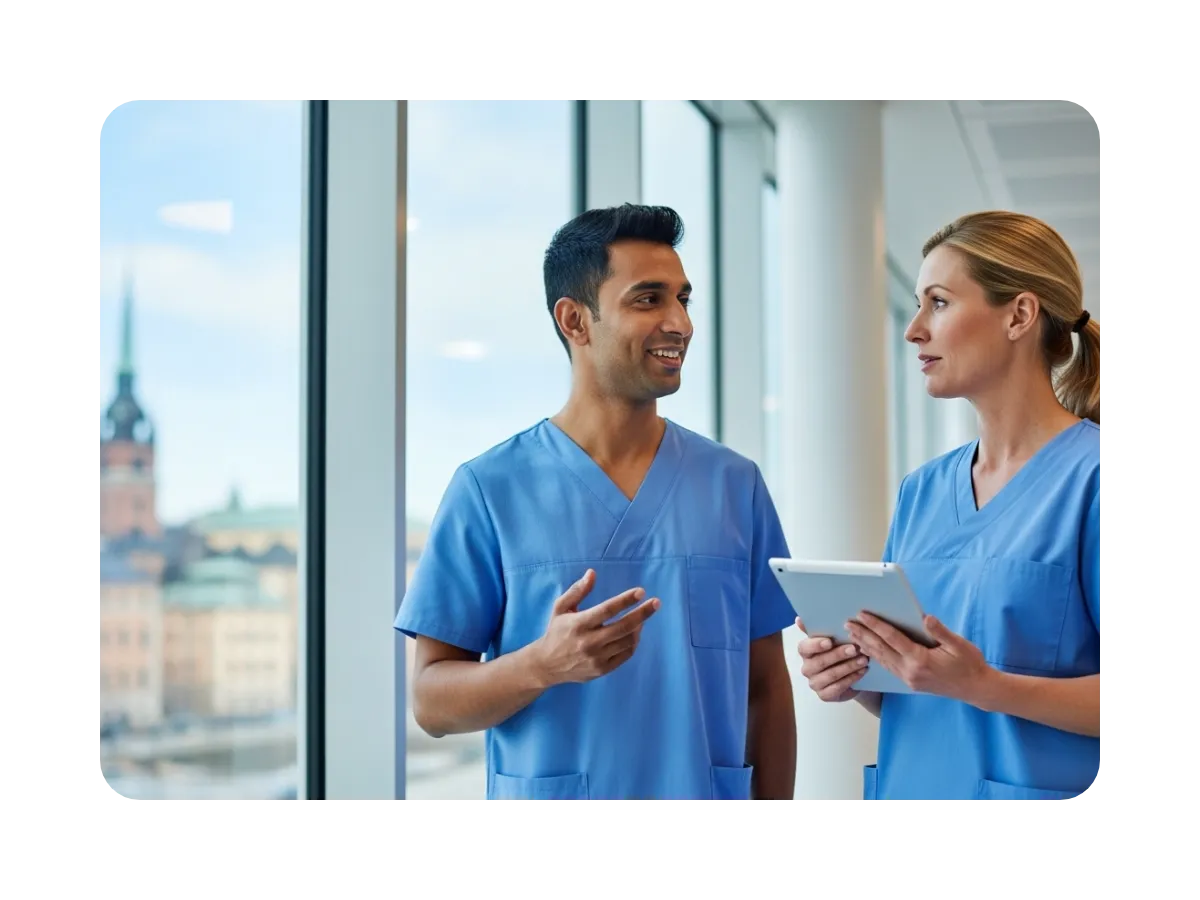
Speechmatics today launched a medical-grade Swedish speech-to-text model achieving 3.91% Keyword Error Rate (KWER) on medical terms. This is 40% lower than the closest competitor, with real-time performance in milliseconds.
The model handles complex Swedish medical terminology, rapid multi-speaker dialogue, and diverse Nordic accents in noisy clinical environments, delivering accuracy that enables reliable automation in patient documentation, ambient scribes, and voice-driven workflows.
The Swedish release expands Speechmatics' Nordic medical lineup alongside Finnish, Danish, and Norwegian models.
This expansion arrives as healthcare organizations increasingly adopt ambient documentation and autonomous AI agents, where transcription accuracy is non-negotiable.
Swedish presents distinct challenges for speech recognition: compound words that combine multiple terms into single units, regional dialectal variation, and pitch accents that change meaning.
Layer in medical domain complexity (pharmaceutical names, dosages, procedures, ICD-10 codes) and the difficulty compounds. Clinicians speak fast, often with overlapping dialogue between patient and provider, in rooms with background noise and interruptions.
Speechmatics approaches these challenges the same way it tackled languages such as Norwegian: collect region-specific training data, model acoustic variation across dialects, and build language models that understand compound word formation rather than memorizing every possible combination.
This philosophy – target the hard cases, not clean demos, enables the model to parse pharmaceutical names spoken with regional accents and handle overlapping speech without attribution errors.
The Swedish medical model was trained on billions of words of medical conversations, clinical documentation, and healthcare interactions. Unlike competitors, Speechmatics builds real-time models first, meaning switching from batch transcription to live ambient scribes doesn't force an accuracy trade-off.
The Swedish medical model delivers:
3.91% KWER on medical test sets: 40% lower error rate than nearest competitor
Sub-second real-time latency: maintains near-batch accuracy at streaming speeds
Expanded medical vocabulary: drugs, dosages, procedures, abbreviations, ICD-10 codes
Accent-independent recognition: handles dialectal variation across Swedish regions
Real-time speaker diarization: distinguishes clinicians, patients, family members in overlapping dialogue
Compound word support: understands Swedish word formation without requiring exhaustive word lists
Results from medical test set include:
Provider | Model | KWER (Lower is better) |
|---|---|---|
Speechmatics | Medical | 3.91% 🏆 |
Chirp_2 | 5.72% | |
AssemblyAI | Universal | 6.05% |
Amazon | Standard | 6.53% |
OpenAI | Whisper-1 | 6.81% |
Deepgram | Nova-3 | 7.87% |
Microsoft | Enhanced | 10.56% |
The 3.91% KWER translates to approximately 1,800 more words transcribed correctly per hour of audio compared to a 6% baseline.
That means:
fewer corrections,
cleaner EHR integration,
and reduced friction in patient interactions.
For clinical documentation workflows, this level of accuracy makes the difference between transcripts that require heavy manual editing and those that can be reviewed and approved with minimal changes.
Speechmatics now supports seven languages with dedicated medical models, including expanding Nordic coverage:
Language | Medical KWER | General WER |
|---|---|---|
Swedish | 3.91% | 7.76% |
Finnish | 5.41% | 6.59% |
Danish | 6.15% | 9.59% |
Norwegian | 7.25% | 7.13% |
This roster enables Nordic healthcare providers to standardize on a single Voice AI platform while supporting native-language workflows across Swedish, Finnish, Danish, and Norwegian operations. It also positions Speechmatics for expansion into emerging multilingual use cases, including code-switching conversations in bilingual clinical environments and cross-border telehealth platforms.
Medical-grade speech recognition is becoming foundational infrastructure for autonomous healthcare agents.
Speechmatics' recent partnership with Sully.ai demonstrates this shift in practice. Sully scaled from single-doctor clinics to enterprise customers with 500+ providers in under a year, deploying AI receptionists and clinical scribes that handle real operational tasks. Their north star metric, Minutes Added to Workforce (MAW), measures how agentic AI drives efficiency within healthcare. As of December 2025, Sully has added more than 30 million minutes back to the healthcare workforce, with customers seeing 21x ROI in early case studies.
"We needed speech models that work in real clinical environments: complex medical terminology, fast overlapping dialogue, accents, imperfect audio. We've seen Speechmatics handle medications better on our troublesome audio than any competitor."
Ahmed Omar, Founder & CEO, Sully.ai
The Swedish launch extends this capability across the Nordics, enabling ambient scribes, AI receptionists, and documentation assistants to operate in native languages without sacrificing the accuracy that makes automation practical.
Healthcare organizations need speech technology that works within their compliance frameworks and operational infrastructure. Speechmatics' Swedish medical model supports on-premises deployment for data residency requirements, on-device processing for edge use cases, and hybrid architectures that balance cloud scalability with regulatory constraints.
This flexibility allows enterprises to adopt Voice AI without compromising on performance, security, or speed.
"High-accuracy, low-latency speech recognition is a core requirement for clinical workflows that operate safely at scale. With Swedish, we're enabling Nordic healthcare organizations to deploy ambient scribes and AI agents without compromising on quality, compliance, or real-time performance."
Yahia Abaza, Product Manager, Speechmatics
The Swedish medical model builds on Speechmatics' September 2025 breakthrough: an English medical model that set industry benchmarks at 93% accuracy (7% WER), 96% medical keyword recall, and a keyword error rate 50% lower than the nearest competitor.
That release, powered by NVIDIA infrastructure and trained on 14 billion words of medical data, established the architecture and training methodology now applied across the Nordic medical lineup.
Each new language undergoes rigorous testing and optimization before release, ensuring the models handle the demands of real healthcare environments: rapid multi-speaker dialogue, medical abbreviations, drug dosages, and diverse accents.
The result is consistent high performance across languages, with deployment flexibility that supports ambient scribes, telehealth platforms, clinical contact centers, and EHR-connected documentation tools.
Speechmatics continues expanding its medical language portfolio, with additional languages rolling out on request.
The company is also investing in emerging medical AI workflows, including autonomous agents that handle patient access, appointment scheduling, and care coordination, use cases where speech accuracy directly impacts operational efficiency and patient experience.
Nordic healthcare organizations can begin testing the Swedish medical model today through the Speechmatics Portal and API, with support for both real-time and batch transcription workflows.
Speak to the team: Schedule a technical demo and discuss deployment options for your clinical workflows.
Try it yourself: Access the Swedish medical model through the Speechmatics Portal for immediate testing.


Discover how medical transcription improves clinician productivity by reducing documentation time, streamlining workflows, and supporting patient care.

![[alt: Healthcare is a strain image]](/_next/image?url=https%3A%2F%2Fimages.ctfassets.net%2Fyze1aysi0225%2F4YLB294PotEnVZFTtksUt8%2F0f9e81fbe24027f52d1941713e032217%2Fmedical_blog_header_general_01.webp&w=3840&q=75)
As healthcare systems face growing pressure, multilingual AI could help clinicians navigate language barriers and spend more time with patients.


Ten questions to Stuart Wood, Director of Product, on the economics of speech at scale, how close local accuracy now gets to cloud, and who could benefit from Speechmatics On-Device.


Learn how law firms can reduce deposition costs with AI transcription by saving time, lowering expenses, improving efficiency, and streamlining workflows.

New ways to pay from October 1
Learn what makes voice agents sound natural, including tone, timing, speech patterns, context awareness, interruptions, and conversational responses.