SpeechmaticsEditorial Team

Speechmatics today expanded its Medical Model with German, Danish and Norwegian, bringing the total language count to seven alongside its industry-leading English model.
The expansion, trained on over 2 billion words of medical data, delivers significant accuracy improvements and gives healthcare organizations deployment choice across on-premises, private cloud and SaaS infrastructure.
Each new language undergoes rigorous testing and optimization before release, ensuring the models can handle the demands that define real healthcare environments.
The new language models are trained on over 2 billion words of medical conversations, clinical documentation and healthcare interactions, adding to the 14 billion words of medical data in Speechmatics' existing models.
This training scale enables the models to understand the complexity of real clinical environments: rapid multi-speaker dialogue, medical abbreviations, drug dosages, and diverse accents.
That scale enables the models to handle what generic speech recognition systems miss: the difference between "hypertension" and "hypotension" in a noisy emergency room, a pharmaceutical name spoken with a regional accent, or overlapping speech between clinician and patient during a consultation.
The result is accuracy that changes clinical workflows.
The three new models demonstrate substantial Key Word Error Rate (KWER) reductions using our specially tailored medical keyword test set. This test set was designed to evaluate our models on challenging terminology, across a broad range of scenarios.
On average, Speechmatics has improved Word Error Rate (WER) on medical test sets by around 30–50% across German, Danish and Norwegian compared with previous Speechmatics models. The new models are also around 5–20% lower in word error rate than the closest evaluated competitor on medical test sets for most languages.
German shows one of the most notable uplifts, with error rates reduced by roughly a third versus Speechmatics' previous German Enhanced model on internal medical tests. That improvement is critical in a language dense with compound terms and specialist vocabulary, where a single misplaced token can change clinical meaning.
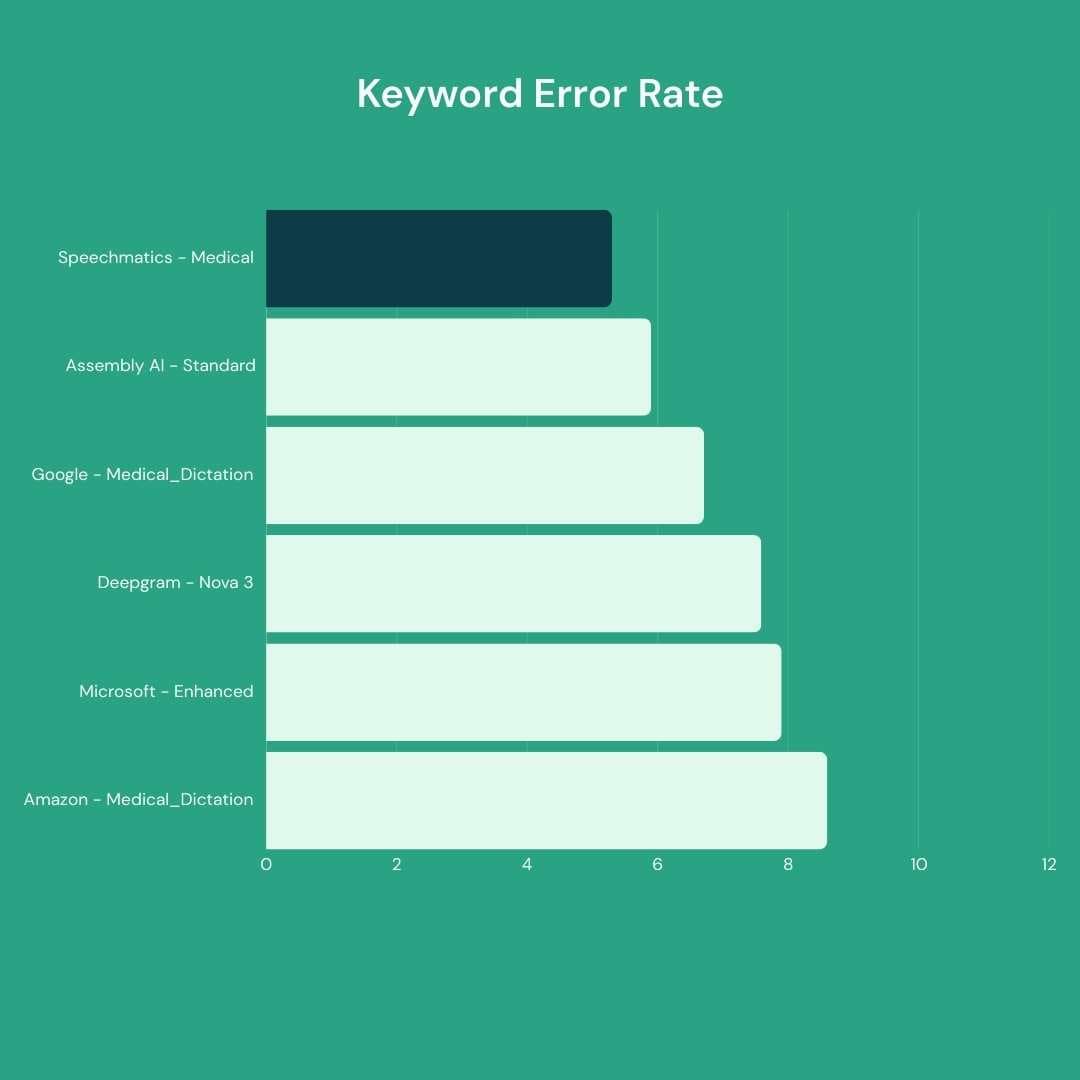
These numbers position Speechmatics ahead of evaluated competitors on medical test sets, with the German Medical Model showing particularly strong performance.
These accuracy gains translate directly to fewer corrections, cleaner EHR integration and reduced friction in patient interactions.
Across our newest medical models, our medical Keyword Error Rates (KWER) performance:
The addition of Danish and Norwegian builds on Speechmatics' Nordic medical coverage alongside Finnish, enabling providers across the region to standardize on a single Voice AI platform while working in their native languages.
The Nordic healthcare market is moving fast on Voice AI adoption, and they expect technology that works without compromise. That requires the rigorous testing and optimization that made our English Medical Model the industry benchmark. We don't compromise on quality when we add new languages.
Yahia Abaza, Product Manager, Speechmatics
The new multilingual Medical Model is available across on-premises, private cloud and SaaS infrastructure, giving healthcare organizations the flexibility to choose the deployment model that fits their compliance requirements, IT infrastructure and operational priorities.
This flexibility has proven critical for Speechmatics' expanding global medical client base. Whether a healthcare provider in Germany needs on-premises deployment for data residency, a telehealth platform in Spain wants private cloud, or an AI scribe company in the Netherlands prefers cloud-native SaaS, organizations can adopt Voice AI without compromising on either performance or their specific regulatory and operational requirements.
Real-time performance is at the center of the release. The medical models are designed to power live ambient scribes, telehealth, clinical contact centers and in-room assistants without forcing developers to trade accuracy for latency.
Above typical real-time latency thresholds, the models remain close to batch accuracy, and under one second they perform strongly compared with competing systems. That allows clinicians to see transcripts and summaries emerge as they speak, while back-office workflows can use the same models for high-volume file processing.
Ambient AI only helps if it keeps up with real clinical conversations. We built these models for fast, overlapping dialogue, non-native speakers, accents and imperfect audio, not just clean test clips. Real-time is the default use case, not an afterthought.
Stuart Wood, Senior Product Manager, Speechmatics
The seven language models build on the foundation of Speechmatics' English Medical Model, which set industry benchmarks in September 2025: 93% general real-time accuracy (7% WER), 96% medical keyword recall, and a keyword error rate 50% lower than the nearest competitor.
All models are optimized using NVIDIA GPU infrastructure, delivering the same level of performance across languages and handling the full complexity of clinical environments. Whether processing real-time ambient scribes or high-volume batch transcription, the models maintain consistent accuracy without forcing organizations to choose between speed and precision.
The expanded Medical Model with German, Danish and Norwegian is now available for production usage. Access is available through:
Speechmatics Portal for direct testing and evaluation
API integration for production deployment across real-time and batch workflows
On-premises and private cloud deployment for regulated healthcare environments
Healthcare technology partners can begin testing today. For more information, to provide feedback, or to schedule a technical demo, visit Speechmatics’ website or contact the team directly.





![[alt: Healthcare is a strain image]](/_next/image?url=https%3A%2F%2Fimages.ctfassets.net%2Fyze1aysi0225%2F4YLB294PotEnVZFTtksUt8%2F0f9e81fbe24027f52d1941713e032217%2Fmedical_blog_header_general_01.webp&w=3840&q=75)