SpeechmaticsEditorial team
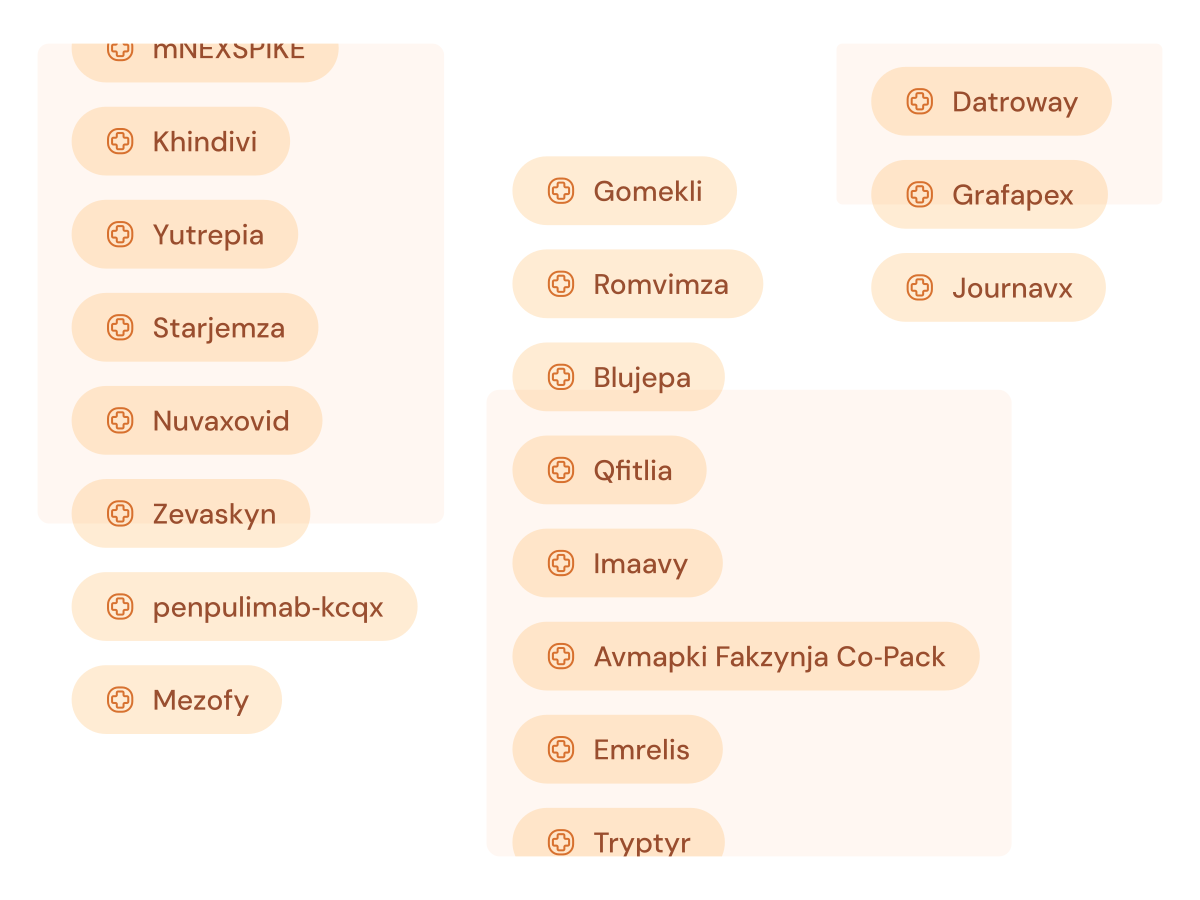
With 93% accuracy and 50% fewer keyword errors than the next best system, our new medical model sets the bar for real-time clinical transcription.
The potential of AI-powered medical transcription has always been transformative: reduce screen time, streamline documentation, and free clinicians to focus on patients instead of keyboards.
This promise is driving fast adoption as new players outcompete legacy incumbent technology while improving the doctor/patient experience, with the global market projected to reach $8.41 billion by 2032, and 30% of US healthcare providers expected to adopt ambient scribes by end-2025.
But most models crumble under the pressure of real clinical environments, mishearing drug names, mangling ICD codes, and struggling with the rapid-fire complexity of medical conversations.
Speechmatics' new Medical Model is built to change this.
As the leader in the real-time streaming speech-to-text (STT) space, Speechmatics has released this domain-specific model for HealthTech partners requiring advanced accuracy, particularly across broad medical terminology and in clinical environments where live note-taking and dictation are critical.
Speechmatics has consistently outperformed specialist medical model providers across a broad range of languages in both file-based and streaming modes.
The Medical Model delivers 93% accuracy, 50% fewer keyword errors, and 17% fewer word errors than the next best system, positioning Speechmatics further ahead of other live streaming STT providers.
Keyword Error Rate (KWER) is the metric that matters most in a clinical setting: it measures how often a system gets the terms that actually change patient outcomes wrong, drug names, dosages, procedures, diagnoses. On this measure, Speechmatics leads by a wide margin.
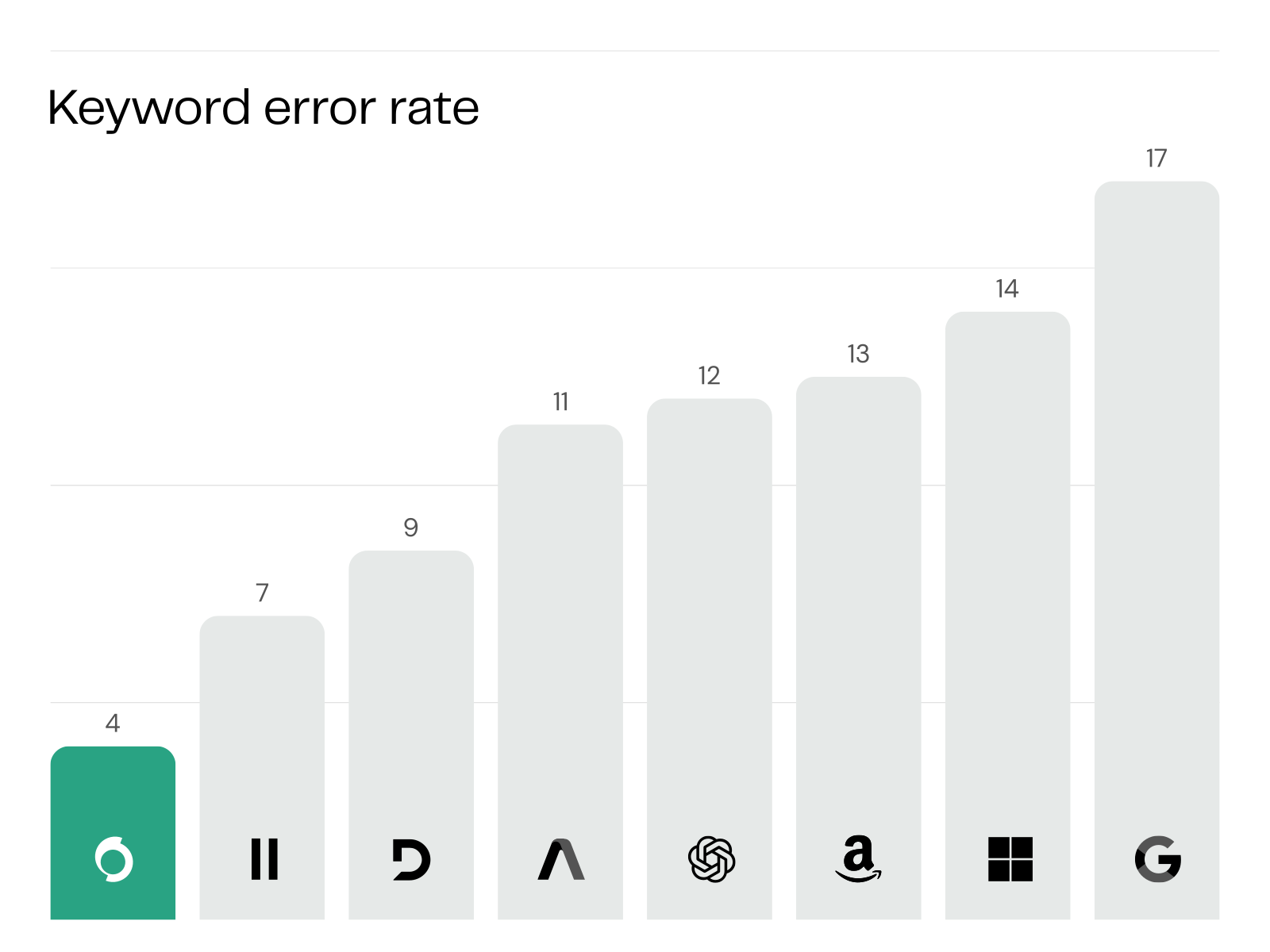
At 4% KWER, Speechmatics is closer to half the error rate of the nearest competitor, and less than a quarter of the error rate at the bottom of the chart. In a live consultation, that's the difference between a dosage transcribed correctly the first time and a note that needs correcting before it ever reaches a patient's record.
In healthcare, conversations move fast.
They're full of shorthand, acronyms, multiple speakers and critical decisions made in seconds.
Most transcription tools are trained for structured dictation, but real clinical dialogue is something else entirely, unstructured, rapid-fire, and packed with context that changes meaning.
This challenge is compounded by the accelerating pace of medical knowledge: what took 50 years to double in 1950 now doubles every 73 days, making AI-driven support systems critical to help clinicians process and apply this overwhelming volume of information in real-time conversations.
Speechmatics' Medical Model is tuned for these real-world conversations, where speed, context, and precision are fundamental.
It's designed to support use cases where transcription needs to keep pace with care, such as:
Contact center triage
Ambient scribes and EHR integrations
In-room consultations and dictation
Telemedicine appointments
The English Medical Model was only the starting point. Since launch, we've extended the same approach, train on real clinical audio, tune for the terms that matter, benchmark against the hardest cases, to a growing list of languages:
, trained on over 2 billion words of medical conversation and clinical documentation, bringing the Medical Model to seven languages total and cutting error rates by up to 50% in each.
, achieving 3.91% KWER and 40% fewer errors than the closest competitor, rounding out a Nordic medical lineup alongside Finnish, Danish, and Norwegian.
, the first medical model built to handle code-switching between the two languages mid-sentence, trained on twice the clinical vocabulary of the English model to correctly transcribe drug names, dosages, and shorthand regardless of which language carries them.
Each new language model goes through the same rigorous testing before release: real clinical audio, regional accents, and the compound terminology that trips up general-purpose models. The goal isn't just translation, it's clinical-grade accuracy everywhere Speechmatics operates, with full multilingual coverage across 56+ supported languages on the roadmap.
In reality, medical professionals and patients speak in a range of accents. Your model needs to be able to understand every voice. This is not the case for the majority of models, which struggle with anything beyond standard pronunciation and mainstream voices.
Speechmatics' Medical Model, however, excels where others falter. Built on our accent-independent foundation that recognizes voices across 56+ languages, the model handles the linguistic diversity of modern healthcare, from emergency calls with heavy regional accents to consultations with international specialists.
Our system delivers clinical-grade accuracy regardless of how doctors, nurses, or patients actually speak.
This foundation enables our new model to recognize and correctly transcribe:
ICD-10-CM codes
Clinical acronyms and shorthand
Drug names and procedures
Prescriptions and dosages
Phone numbers, addresses, and patient names
Essential to accurate clinical documentation, these areas are often misrecognized by both specialized and general-purpose models.
The Medical Model delivers superior accuracy for live workflows compared to traditional batch processing approaches.
Real-world data reveals the scale of impact. A recent JAMA study found virtual scribes cut total EHR time by 5.6 minutes per appointment, including 1.3 minutes less note-taking and 1.1 minutes less "pajama time" (after-hours documentation).
Research has also shown that "power users" see even bigger gains: a follow-up evaluation showed the top 33% of clinicians (by usage) achieving 2.5x greater time savings per note than lower-frequency users.
This proven reliability extends to mission-critical settings like ambulance services, where Speechmatics currently powers transcription for every emergency call across the UK, operating under a 100% uptime guarantee where reliability is literally a matter of life and death.
For clinical teams and healthtech providers, this translates to faster, cleaner EHR integration, less time spent correcting errors, and reduced friction in patient interactions.
"We're seeing great results already with Speechmatics. It's performing well in live deployments and accelerating our clients' efficiency at scale."
– Martin Taylor, CTO, Content Guru
Healthcare data demands the highest security standards, and the Medical Model delivers comprehensive protection:
HIPAA-compliant infrastructure
Zero data retention
Encryption in transit and at rest
Audit trail support
Available now in preview via SaaS
On-prem availability for enterprise customers
Partners working in regulated healthcare environments have found confidence in Speechmatics' approach to compliance.
As a global ambient scribe customer shared:
Being in a regulated industry means data security, privacy, and compliance are top priorities for us. We've been reassured by how Speechmatics handles sensitive information and follows strict standards. The willingness of the team to understand and accommodate these regulations has really stood out and given us the peace of mind we need to stay compliant in all our processes.
If you're developing healthcare applications, from dictation tools and scribe systems to AI assistants, and need a transcription engine optimized for real-time medical speech, the Speechmatics Medical Model is available now.
Ready to see clinical-grade transcription in action? Head to Speechmatics' Portal to use the Medical Model directly.




![[alt: Healthcare is a strain image]](/_next/image?url=https%3A%2F%2Fimages.ctfassets.net%2Fyze1aysi0225%2F4YLB294PotEnVZFTtksUt8%2F0f9e81fbe24027f52d1941713e032217%2Fmedical_blog_header_general_01.webp&w=3840&q=75)




![[alt: Dark teal banner for Agent STT, with a cyan audio-wave logo and text: “Speech-to-text purpose built for voice agents.”]](/_next/image?url=https%3A%2F%2Fimages.ctfassets.net%2Fyze1aysi0225%2F2dxy1TDbcnumiCFjG02CW7%2Fa6efeb049451db1e3339f839259fa16c%2Fagent-stt-blog-800x500.webp&w=3840&q=75)