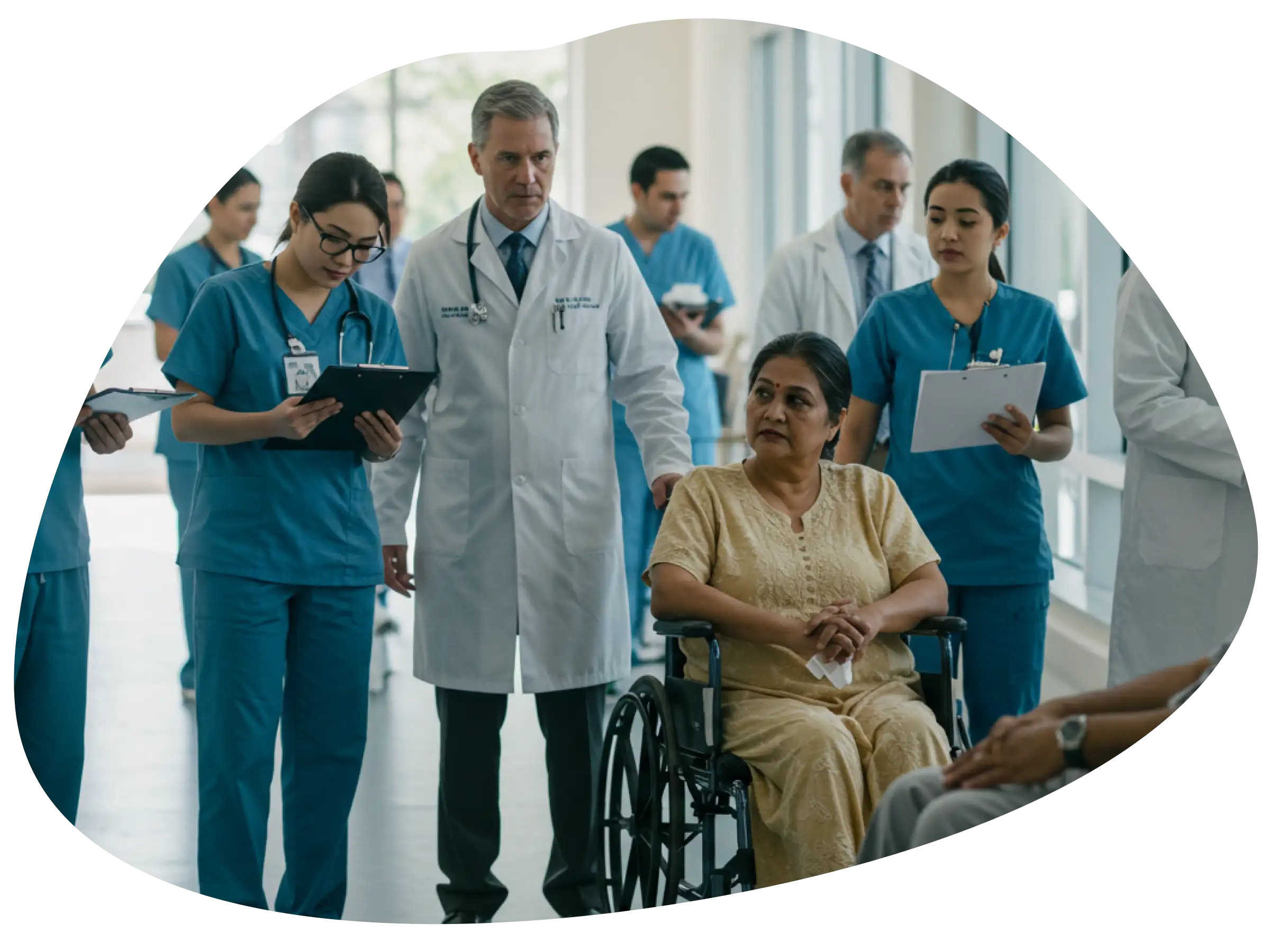
In a South American doctor’s office, a patient moves fluidly between Spanish and English. In Australia, where more than 5.6 million people speak a language other than English at home, healthcare professionals face the challenge of communicating across hundreds of languages.
Across the globe in a local Devonshire hospital, healthcare staff from 100 different countries struggle to communicate complex medical information across language barriers. Meanwhile, in a Chicago medical center, a physician types furiously into a computer, correcting multilingual patient notes rather than making eye contact – creating a digital wall between clinician and patient.
Having worked with international medical bodies, most recently in Singapore, I've seen first-hand how these communication gaps endanger patients and burn out healthcare workers.
Too often, the burden falls on patients and their families. Children are asked to relay complex medical information, relatives become intermediaries in deeply personal discussions, and professional interpreters may not always be immediately available when they're needed.
And the challenge is growing. According to the Australian Bureau of Statistics, 22% of Australians spoke a language other than English at home in 2021, up from 20.6% in 2016. More than 850,000 people reported speaking English poorly or not at all. For healthcare providers, ensuring patients are understood across languages is an everyday concern.
Then in the UK, 18% of NHS staff in England are non-British nationals, with 35% of doctors and 27% of nurses coming from abroad. In major urban areas like London, the reliance on migrant healthcare workers is even greater.
Yet many healthcare technologies still struggle with the realities of multilingual conversations. Accents, dialects, specialist medical terminology and patients switching between languages can all present challenges for speech recognition systems. When a drug name, dosage or symptom is captured incorrectly, the consequences can extend well beyond an inaccurate transcript.
At Speechmatics, understanding every voice has always been central to our work. Our latest medical speech recognition model, Oak, builds on that commitment. It supports more than 55 languages, follows conversations as speakers switch between languages, and identifies who said what. In benchmarking against eight other providers, Oak captured 91% of medical terms on average, compared with 74.3% across the competition.
For healthcare providers, these advances will make a meaningful difference. Clinical conversations rarely follow a script. Patients may switch languages mid-sentence, family members may contribute to discussions, and clinicians use specialist terminology that needs to be recorded accurately. Better speech recognition could support everything from clinical documentation to multilingual patient intake, while reducing the time spent correcting transcripts.
While healthcare systems worldwide pour billions into robotic surgeons and diagnostic microchips, the fundamental language barrier remains largely overlooked. The future of patient care depends on solving this communication crisis, as misunderstood diagnoses directly compromise treatment outcomes.
In our rush to reinvent medicine with cutting-edge technology, the ability to simply understand one another across languages represents our most essential and immediately solvable innovation.







![[alt: Dark teal banner for Agent STT, with a cyan audio-wave logo and text: “Speech-to-text purpose built for voice agents.”]](/_next/image?url=https%3A%2F%2Fimages.ctfassets.net%2Fyze1aysi0225%2F2dxy1TDbcnumiCFjG02CW7%2Fa6efeb049451db1e3339f839259fa16c%2Fagent-stt-blog-800x500.webp&w=3840&q=75)