
Brad PhippsDirector, SaaS & Infrastructure
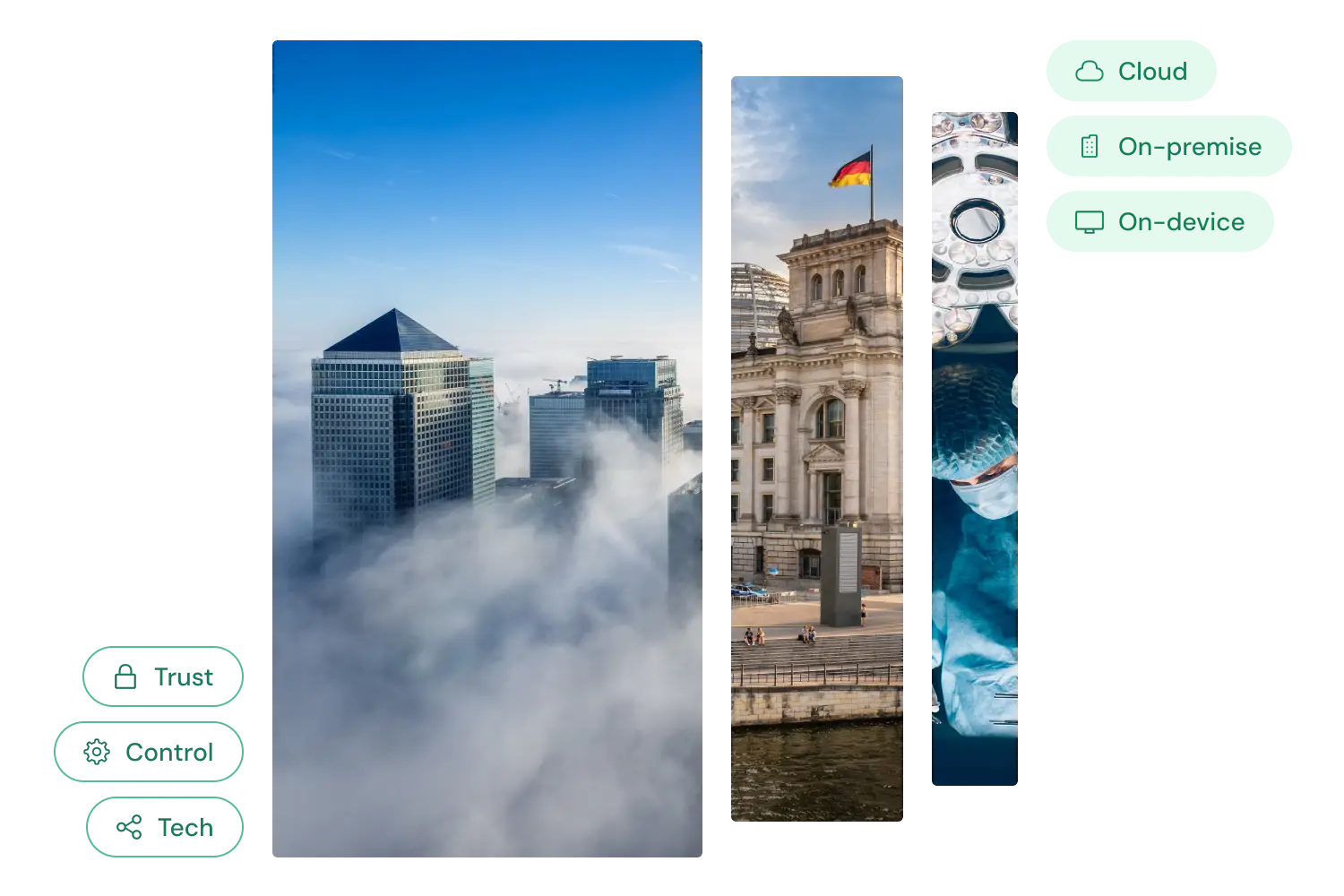
Remember when cloud-first was the tech world’s default mantra? That battle cry is starting to fade.
More organizations are realizing they don’t need to bend to the limitations of the cloud to unlock the benefits of AI. By bringing AI operations back home, they’re regaining control and discovering that innovation can be just as powerful, if not more so, on their own terms.
We’re hearing the same thing from our customers: AI has the power to transform their product offering but their end users won’t accept personal information being processed in a third-party’s cloud. The problem isn’t the cloud itself – it’s the trade-offs that come with it.
In regulated industries where security and compliance aren’t just buzzwords but business imperatives, knowing exactly where your data lives – and understanding your vendors’ incentives – isn’t optional. It’s essential.
On-premise AI gives businesses the control, confidence, and clarity they need to stay compliant, move faster, and compete smarter. Just ask Adobe...
The pendulum is swinging back toward on-premise with purpose rather than nostalgia. Gartner found that 69% of IT leaders reported their cloud budget overrun, while Flexera estimates nearly 30% of enterprise cloud spend is wasted. Unsurprisingly, 83% of CIOs now plan to repatriate at least some workloads.

According to Market.us, the global market for voice AI agents is projected to reach $8.9 billion by 2032, growing at a CAGR of 17.4%.
But with growth comes scrutiny. As voice AI becomes more deeply integrated into finance, healthcare, and government services, organizations are under increasing pressure to meet data privacy expectations and prove compliance.
Regulatory frameworks like the EU AI Act and ISO/IEC 42001 are accelerating this trend, pushing enterprises to take back control of where – and how – their AI operates. For many, that means keeping sensitive workloads on-premise.
We've been aware of this shift for a while, working closely with customers facing these exact challenges. Today, we're incredibly proud to announce On-Premise from Speechmatics: our decisive answer to the industry's growing demand for true data sovereignty.
With Flow On-Premise from Speechmatics, you can deploy an entire Conversational AI API locally in your infrastructure, so that you can guarantee that you are in control of your customer data. This means you can stop paying Legal to analyze the risks of your customers' personal data being sent to a third party whose T&Cs change over time and are full of impenetrable jargon.
On-premise deployment delivers advantages that cloud simply cannot match:
Total data sovereignty: Your data remains behind your firewall, eliminating exposure to third-party clouds
Lightning-fast performance: No internet lag affects your AI agent when everything runs on your local network
Predictable costs: Freedom from surprise usage fees or bandwidth charges
Compliance without compromise: Keeping data on-premise makes regulatory compliance dramatically simpler
Maybe your customers demand certifications such as SOC2 and are beginning to require newer AI specific certifications such as ISO 42001. These certifications must prove that your AI-enabled software suppliers and data processes are trusted, and that you understand the risks and monitor them. Sounds like a major headache for enterprises who have sprawling software stacks and SaaS vendors.
These things considered, many enterprises have decided On-Premise is a binary, non-negotiable decision.
Flow On-Premise can be deployed into a Kubernetes cluster on any cloud provider, hypervisor or even bare metal. You get to decide the release cadence and our charts allow easy version upgrades on a schedule that suits you.
Setting up Flow On-Premise in just three commands.
From here, you have full access to your data, agent prompts and deployment configuration such as language concurrency, multi-node autoscaling logic, observability and SSL certificates.
This chart is the culmination of years running real-time AI systems at scale. By using the Flow On-Premise deployment, you'll be extending on top of our foundational experience and we're really excited to see what you create!
It’s important to note that while on-premise delivers control, cloud solutions still do a job in offering scalability and deployment ease.
A hybrid approach combines the strengths of both - keeping sensitive operations on-premises while leveraging cloud for less sensitive tasks.
According to Flexera's 2024 State of the Cloud Report, 73% of organizations are now using hybrid cloud environments, reflecting the growing demand for flexible infrastructure that balances security with agility.
Flow On-Premise works seamlessly whether you choose all on-prem, in the cloud, a hybrid configuration, or find yourself transitioning between models - giving you the power to futureproof your AI infrastructure without compromise.






![[alt: Illustration representing multilingual code-switching for the Speechmatics Melia 1 speech-to-text model.]](/_next/image?url=https%3A%2F%2Fimages.ctfassets.net%2Fyze1aysi0225%2F2BgLftzAE6cT0uJczif4Cf%2F805533fa6d54351dddd4a4c1f1ba424e%2FMelia-codeswitching-header.webp&w=3840&q=75)
![[alt: Dark grid background with a circular symbol on the left and a pixelated "K" on the right connected by a cyan line.]](/_next/image?url=https%3A%2F%2Fimages.ctfassets.net%2Fyze1aysi0225%2F24PivVEjmscf5DwtdLPn8P%2F36637a2ef67e1e5b16a1560b3ca524b0%2FLiveKit_Inference-Social-dark.webp&w=3840&q=75)
![[alt: Three blue folders on an orange background, labeled for processing audio files of varying lengths in seconds.]](/_next/image?url=https%3A%2F%2Fimages.ctfassets.net%2Fyze1aysi0225%2F642dhRW3whpEWyQ1OimLTW%2F19aa090e4e0a35f8a0494eb0db84f864%2FMelia-TAT-Social.webp&w=3840&q=75)