SpeechmaticsEditorial Team
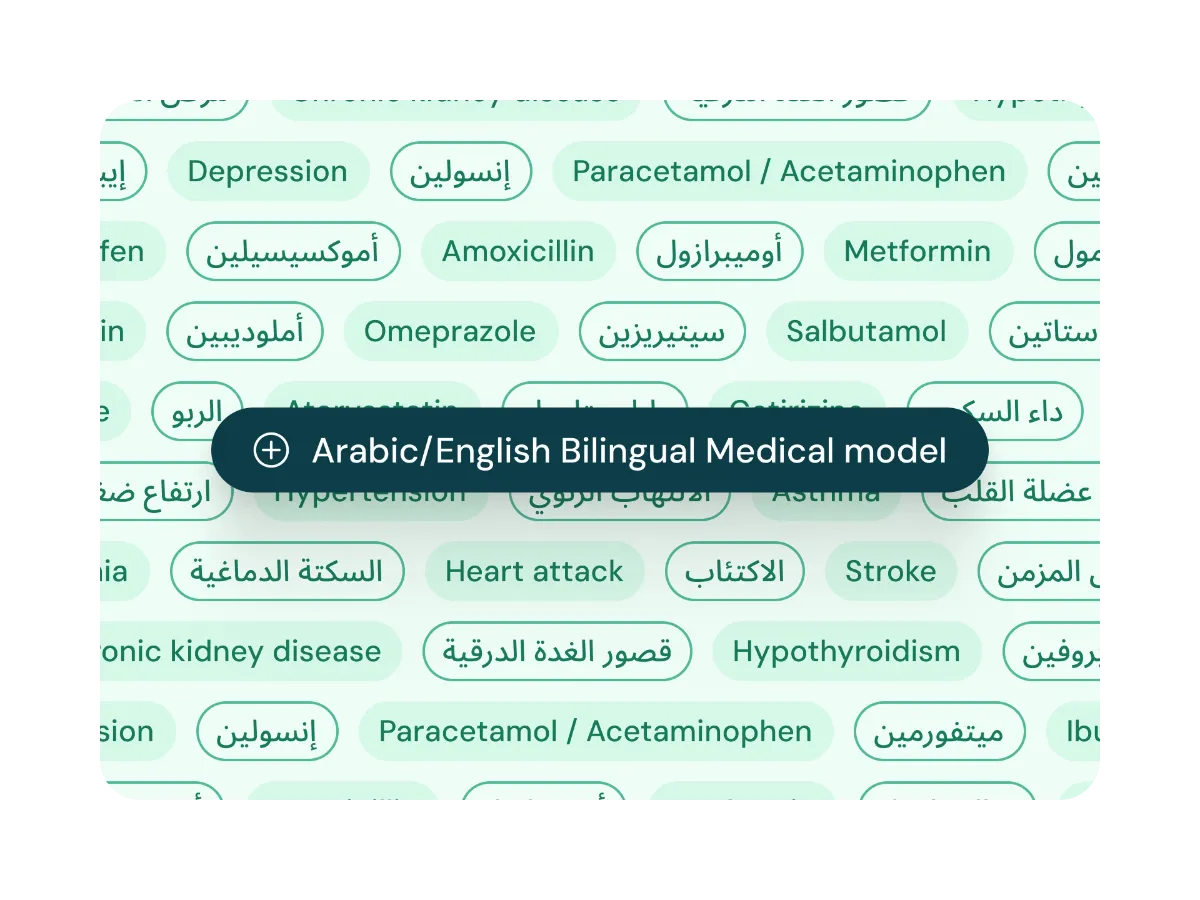
Powered by Nvidia, the new industry-leading bilingual model includes the world's first Arabic–English bilingual medical model, achieving 6.3% WER on mixed-speech benchmarks and 35% fewer errors than the nearest competitor.
Speechmatics today launched its new Arabic–English bilingual model, a single production-ready model that handles Arabic dialects and English simultaneously. It can be deployed on-premises and on-device, supports speaker diarization and speaker focus, and runs across real-time and batch workflows.
As part of the rollout, Speechmatics introduces the world's first Arabic–English bilingual medical model: a specialized clinical variant trained on twice the vocabulary of its English Medical Model, built to ensure that patient records are always accurate and up to date.
A doctor names a drug in English then switches back to Arabic. A Gulf contact center agent shifts registers without thinking. A finance officer moves across both languages in a single sentence. Across MENA, this is Monday morning.
Monolingual models weren't built for this. When a speaker shifts between Arabic and English mid-sentence, the model loses the thread - misattributing words, dropping terminology, or simply getting it wrong. In contact centers or for medical transcription, that's not an edge case. It's the norm.
Our model, tailored to support both languages, resolves this issue, with speaker diarization and speaker focus ensuring every word is attributed to the right person throughout. In new benchmarking, Speechmatics achieves a 35% lower Word Error Rate than Google on Arabic–English code-switching tasks (6.3% vs 9.7%), making it the most accurate code-switching model available
Arabic carries distinct vocabulary, phonology, and rhythm across the region, including Gulf, Egyptian and Levantine dialects. Models trained on broadcast Modern Standard Arabic struggle the moment a real conversation starts.
Speechmatics leads major providers on Arabic-only transcription, delivering 24% lower Word Error Rate than Google (4.5% vs 5.9%) and outperforming OpenAI Whisper, AssemblyAI, Deepgram, Amazon, and Microsoft.

Data sovereignty is a hard requirement across MENA, with regional data protection legislation in Saudi Arabia, the UAE, and beyond placing strict obligations on where voice data is processed and stored. Speechmatics meets this directly.
"This was critical to achieving meaningful outcomes for customers across the region who kept describing the same challenge. In a Cairo hospital or a Riyadh contact center, Arabic and English flow concurrently - the drug name arrives in English, the rest of the sentence is Arabic. Delivering significant impact meant removing that friction from voice interactions. We trained on real voices, real dialects and real clinical vocabulary - because that’s the only way to build something that truly works where it’s used.”
Katy Wigdahl
CEO, Speechmatics
The model deploys across cloud SaaS, on-premises, and on-device, powered by NVIDIA AI infrastructure and optimized through NVIDIA Dynamo-Triton for high-throughput, low-latency processing at scale. Sub-second latency is maintained across all deployment modes.
Real-time streaming and batch transcription run on the same model, removing the accuracy trade-off that typically comes with switching between the two. Speaker diarization, speaker focus, punctuated transcripts, and timestamped outputs are included as standard.
In clinical environments across MENA, English drug names, procedures, and dosages appear constantly inside Arabic speech. Generic models mishandle them, and those errors can land in the patient record.
Trained on twice the vocabulary of Speechmatics' English Medical Model, incorporating both English and Arabic clinical terminology, real dialect variation, and speech from actual clinical settings, the world's first Arabic–English bilingual medical model accurately transcribes ICD-10-CM codes, drug names, dosages, and clinical shorthand regardless of which language carries them. On-premises and on-device deployment make it viable for the regulated environments where clinical AI is increasingly being built across the region.
"We ran extensive evaluations on complex code-switching and dialect-heavy consultations across MENA. Speechmatics' bilingual medical model was the only one that met performance thresholds we require to maintain high-quality clinical documentation as we scale regionally. That alignment made the partnership a strong fit for our expansion."
Patrick Nguyen
Head of Engineering, MENA, Sully.ai
Both models are available now in our portal to test for yourself.



![[alt: Healthcare is a strain image]](/_next/image?url=https%3A%2F%2Fimages.ctfassets.net%2Fyze1aysi0225%2F4YLB294PotEnVZFTtksUt8%2F0f9e81fbe24027f52d1941713e032217%2Fmedical_blog_header_general_01.webp&w=3840&q=75)