SpeechmaticsEditorial Team
There's a version of AI clinical documentation that sounds simple: record the consultation, transcribe it, generate the report. Clean pipeline. Obvious value.
Then real patients show up.
They speak with accents. They get emotional. They're anxious, or medicated, or elderly. They say things that are technically true but clinically misleading. The doctor speaks in shorthand that would confuse anyone without years of training.
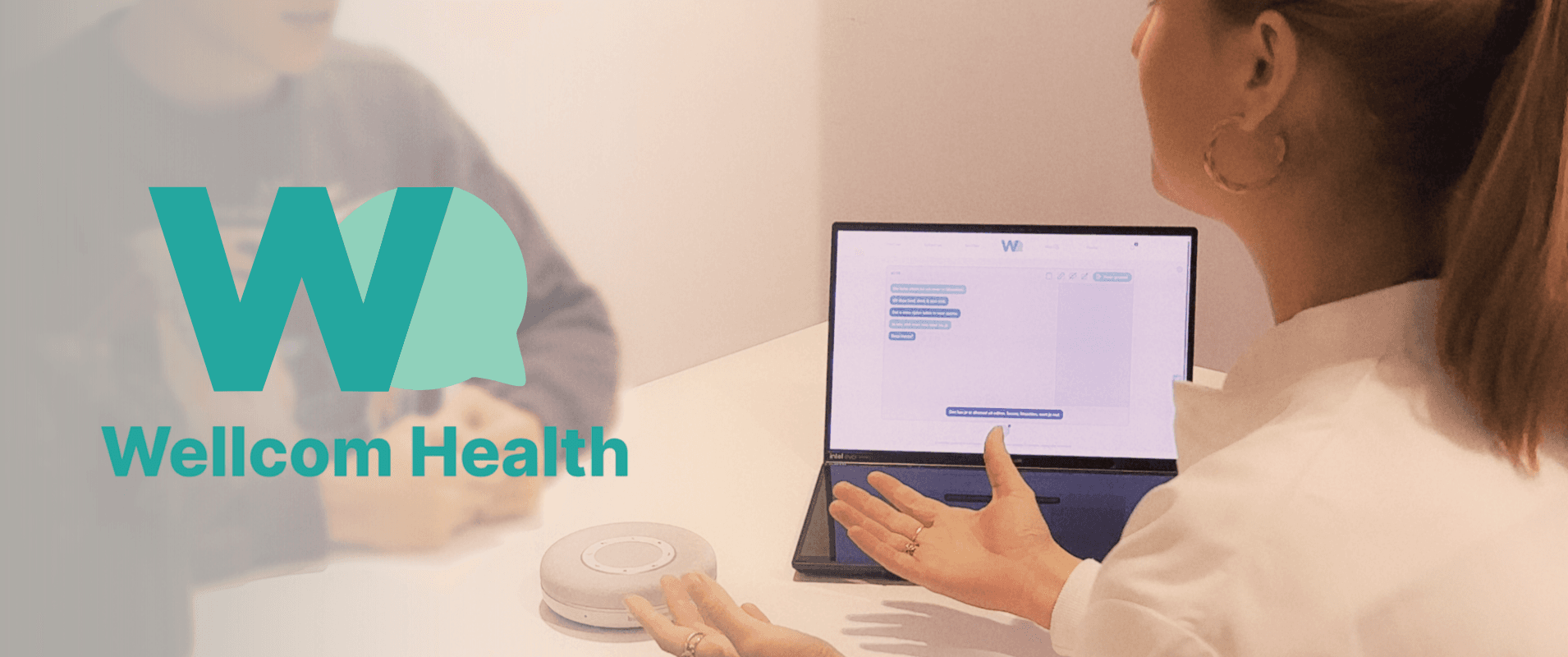
Wellcom Health, a healthtech startup based in the Netherlands, builds AI documentation tools for exactly this environment. Their product takes a spoken clinical consultation and turns it into a structured, validated report ready for the EHR.
To accelerate their work in building clinical AI for Dutch healthcare, they joined Speechmatics' Startup Program, being one of the first companies to do so. Using Speechmatics' real-time API, medical model, and diarization, their usage skyrocketed, quickly placing them among the highest-volume users across the entire first cohort.
Founders Thijs Rood, Victor van der Kooij and Fabian Pusceddu joined us to talk about why healthcare audio breaks most AI models, what it takes to build a validation layer clinicians actually trust, and how a Dutch startup became one of the fastest-growing users in Speechmatics' first cohort.
Clinical note-taking used to happen after everything else. A clinician would see one patient, then another, then another, and only then sit down to write up their notes. Three consecutive consultations meant three reports reconstructed from memory, with detail fading between each one.
A lot of the time these professionals were busy at least 20%, 25% of their day doing report writing. There are now a lot of our users who say they can do it in just a fraction of the time.
But the efficiency gain only holds if the underlying transcript is reliable.
Wellcom's pipeline starts with real-time transcription and ends with a structured clinical report in the EHR. Every stage in between, the summary, the report formatting, the validation check, depends on the quality of what came before it. A transcript is the first artifact, what has to happen before it becomes a usable clinical workflow.
Healthcare audio is genuinely hard. Patients may have difficulties speaking or hearing, may be distressed, or crying.
Dutch healthcare adds structural complexity: independent GP practices with no centralized infrastructure, occupational health physicians working across client sites, a patient population that reflects the full linguistic diversity of the Netherlands and Belgium.
Speaker attribution is where the stakes get clinical. Who said what in a consultation changes the meaning of the report entirely. Wellcom gives a precise example: a patient tells their doctor they have a headache and that they're probably pregnant. The doctor responds with alternative explanations.
Without accurate diarization, the report can record the pregnancy assumption as clinical fact, because it was said in the room, by someone. The transcript captures the words. The report gets the meaning wrong.
The Wellcom team tried building their own transcription models first, then tested third-party providers. Neither worked well enough for clinical use. Physicians are not forgiving testers. They work with language every day. When a transcript is wrong, they say so.
The quality could be good with self-made models, but it would be more expensive. The quality of other companies was sometimes lower. And the physicians noticed — they wanted a higher quality of transcription. That has definitely improved since we've been using Speechmatics.
Wellcom now builds on three core Speechmatics capabilities. The real-time API powers live transcription during the consultation itself, meaning the transcript is ready the moment the conversation ends.
The Dutch enhanced medical model handles the specific demands of clinical Dutch: regional dialects, non-native speakers, and the specialist terminology that generic models consistently get wrong. And diarisation handles speaker separation, giving Wellcom the foundation they need to attribute advice, diagnoses, and patient statements to the right person in the report.
Each of those capabilities feeds directly into the pipeline. Without real-time transcription, the workflow breaks down. Without medical-grade accuracy, the validation layer has nothing reliable to check against. Without diarisation, the attribution problem remains unsolved at the source.
The proof is in the outcomes. Since switching, the complaints stopped.
We haven't had any more complaints about the quality of the transcript. That has of course also improved the reports we have been generating.
Integration was fast too.
It was only a few hours to integrate, and it's already worked quite well in what we have built.
Within months of joining Speechmatics' Startup Program as one of its first cohort, Wellcom had become one of its highest-volume users, their usage growing faster than almost any other company in the program.
Once the transcript is made, Wellcom runs it through three stages before it reaches the clinician.
The first is a master prompt layer that suppresses hallucinations and keeps the AI within strict limits. The system will not infer urgency or suggest diagnoses based on subtext. Only what was explicitly stated makes it through.
The second is the Template Studio. Clinicians define the structure and content priorities of their own reports, and the AI renders the transcript into that format. Every clinician gets documentation that fits how they actually work. This turned out to be Wellcom's hardest product problem to solve.
This was 100% our biggest struggle. There are a lot of different types of doctors, and then even within the same company, there are different people who use different types of reports.
The solution is a shared company baseline that individual clinicians customize from. The variation is preserved. The quality controls sit underneath all of it.
The third stage is validation.
We validate everything that's in the report through the transcript that's been made. The word has to be in the report and also in the transcript. There needs to be correlation between those two.
Content has to be traceable to what was actually said. If it isn't in the transcript, it doesn't go in the report.
Wellcom offers two approaches to data handling. Zero retention, where everything is deleted from their servers once the report is copied to clipboard. And a 14-day processing window, which gives clinicians time to review, edit, and push to the EHR without doing it immediately after the consultation.
Most clinicians use the 14-day window. The zero-retention option exists for cases where it's required.
We are not an EHR. We don't want to try to be an EHR. We are there delivering the information in a structured way into the EHR. That's our main focus.
Most AI documentation tools are built for the easy version of the problem: a quiet room, two clear voices, one language, clean audio. Wellcom built for the version that actually exists.
That means a pipeline rigorous enough to catch what generic models miss, a validation layer that keeps clinical records honest, and a transcription foundation accurate enough to make everything on top of it worth building. It also means being honest about what isn't solved yet. Speaker diarisation in challenging acoustic conditions remains hard, and the team says so directly. They're working through it with Speechmatics.
What Wellcom has demonstrated is that getting the speech layer right isn't a precondition for building something useful. It's the thing that determines whether what you build is trustworthy. Every summary, every report, every EHR entry traces back to a single moment: what was said in the room, and whether the transcript captured it accurately.
The input data is the basis for the output data. If the transcript is good, then of course the report is going to be better as well.
In healthcare, the accuracy of a clinical record is the product.
About Wellcom Health
Wellcom Health started with a simple observation: clinicians were spending a quarter of their day writing up notes from memory, and nobody had properly fixed it. Built for the complexity of Dutch healthcare, their platform handles the full documentation pipeline, from real-time transcription to validated, structured reports delivered into the EHR. They serve GPs, psychologists, psychiatrists, and occupational health physicians across the Netherlands and Belgium, and have built one of the more technically rigorous approaches to the hallucination and speaker attribution problems that make clinical AI genuinely hard. Learn more about Wellcom Health.
Learn more about Speechmatics' medical model.
Building a startup? Check out our startup program.





![[alt: Healthcare is a strain image]](/_next/image?url=https%3A%2F%2Fimages.ctfassets.net%2Fyze1aysi0225%2F4YLB294PotEnVZFTtksUt8%2F0f9e81fbe24027f52d1941713e032217%2Fmedical_blog_header_general_01.webp&w=3840&q=75)