
SpeechmaticsEditorial Team
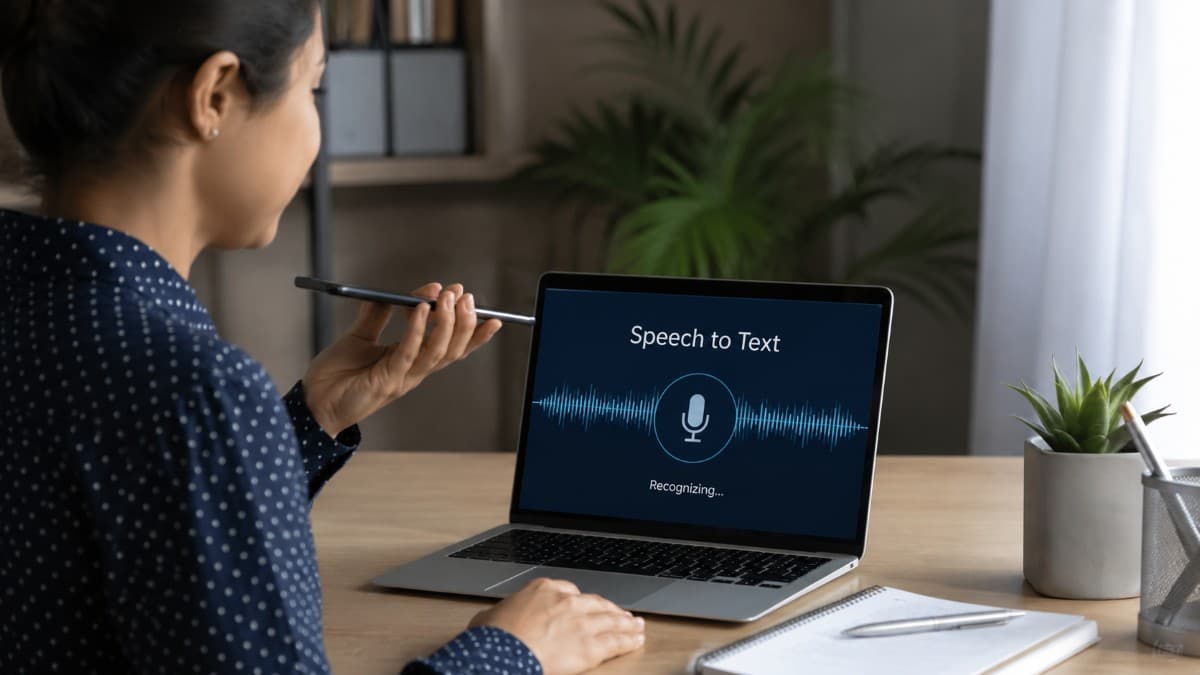
Speech is one of the richest sources of business data, but it is also one of the hardest to use. Customer calls, meetings, interviews, broadcasts, and clinical conversations all contain information teams want to search, analyze, and act on. The problem is simple: audio is not naturally structured.
Before spoken language can be summarized, analyzed, or fed into downstream AI systems, it first needs to be transcribed. That is where speech-to-text AI comes in.
Modern speech recognition systems can turn live or recorded audio into text in seconds. They now sit underneath live captions, contact center analytics, media workflows, voice agents, and ambient clinical documentation. What changed is the ability to handle the kind of speech that shows up in production: different accents, background noise, multiple speakers, domain terminology, and conversations that don't follow a script.
Speech-to-text AI, often called automatic speech recognition or ASR, is technology that converts spoken language into written text using machine learning.
Older speech recognition systems relied heavily on fixed vocabularies, pronunciation dictionaries, and hand-built language rules. They worked best in narrow conditions and often broke when audio became noisy or speakers moved outside the accents and speech patterns the system expected.
Modern systems work differently. They are trained on large datasets of recorded speech so they can learn patterns in how people actually talk. That includes pronunciation, rhythm, sentence structure, and context. Instead of trying to map sound to words with rigid rules, the model learns probabilities across large volumes of real speech.
That shift is what made speech recognition useful at scale. Today, speech-to-text AI can transcribe everything from podcasts and earnings calls to emergency dispatch audio and doctor-patient conversations.
Although different platforms use different model architectures, most speech-to-text systems follow the same basic sequence: capture the audio, process it, recognize the words, and return a usable transcript.
It starts with an audio input. That could be a live microphone stream, a phone call, a video file, or a recorded conversation uploaded after the fact.
Before the AI begins transcription, the system prepares that audio for recognition. This usually involves converting the sound into a machine-readable representation and extracting features that make speech easier for the model to interpret. Depending on the system, preprocessing may also help reduce background noise or normalize differences in volume.
This step matters because real audio is messy. Call center audio has crosstalk. Meeting recordings have room echo. Broadcast clips may contain music beds or overlapping speakers. Clinical environments include interruptions, movement, and equipment noise. A strong speech-to-text system has to handle those conditions, not just clean studio audio.
Once the audio has been processed, the model begins identifying what was said.
Modern systems typically use deep neural networks trained to recognize patterns in speech across time. Rather than evaluating one isolated sound at a time, they analyze sequences. That allows the system to understand how phonetic units combine into words and how words appear in context.
This is why training data quality matters so much. A model trained on broad, diverse speech data will generally perform better across accents, speaking styles, and recording conditions. A model trained mostly on clean, narrow datasets may look strong in a demo but struggle once real users show up.
Recognizing sounds is only part of the job. Human speech is ambiguous.
People hesitate, restart, interrupt each other, and use words that sound alike but mean different things. A speech-to-text system has to decide which word is most likely based not only on the sound itself, but on the words around it.
That is where language modeling comes in. Context helps the system determine whether a speaker said "their," "there," or "they're," and whether a phrase fits the flow of the sentence. In business settings, this becomes even more important when domain-specific terms are involved. A medical consultation, a legal proceeding, and a product support call all use language differently.
The stronger the system is at combining acoustic recognition with contextual language understanding, the more readable and reliable the transcript becomes.
Once the system has identified the words, it produces a transcript.
In practice, enterprise speech-to-text output is usually more than plain text. Many platforms add punctuation, timestamps, speaker labels, and confidence scores. Some also support speaker diarization, which separates who said what in a multi-speaker conversation.
Those details are what make transcription operationally useful. A raw wall of text is hard to search, review, or analyze. A structured transcript can feed analytics systems, support compliance workflows, improve accessibility, and serve as input for summarization or other AI tasks.
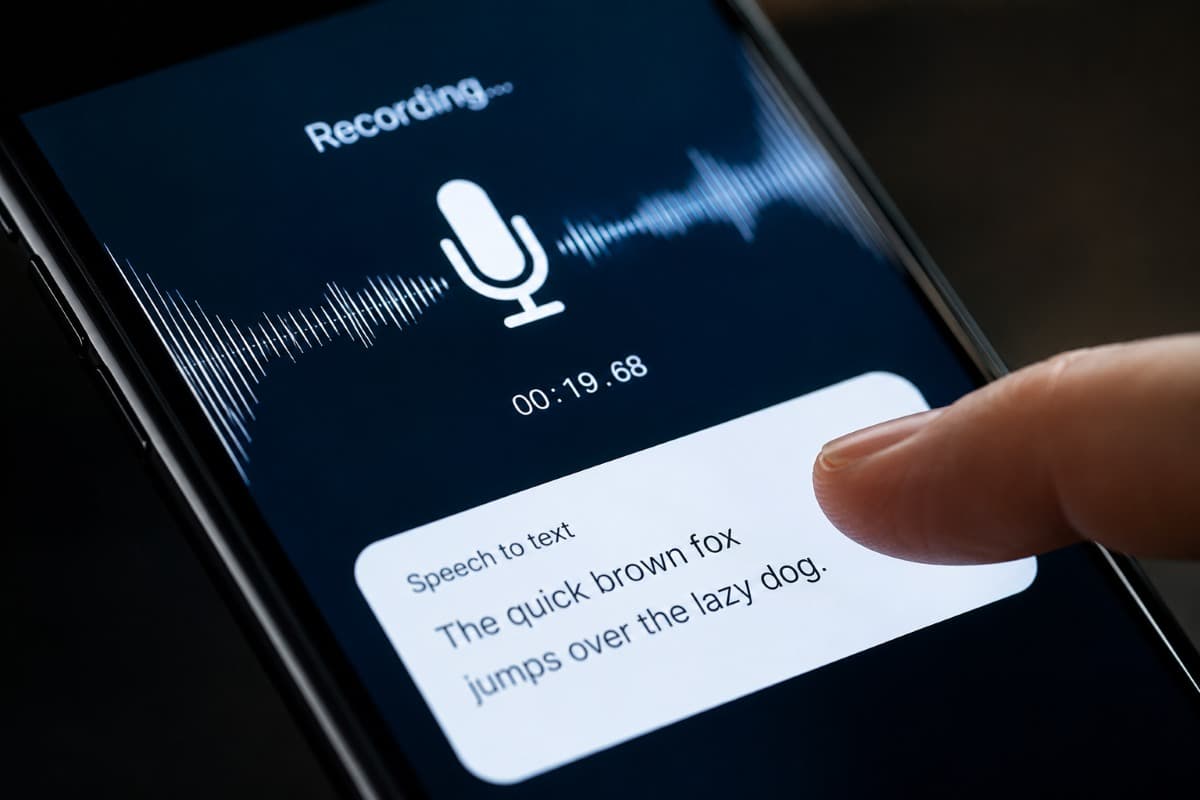
From there, the main operational decision is how the transcript needs to be delivered.
Speech-to-text AI generally runs in one of two modes: real time or batch.
Real-time transcription processes speech as it is happening. This is essential for live captions, voice interfaces, call assistance, and conversational AI, where latency matters as much as accuracy. If text arrives too slowly, the user experience breaks.
Batch transcription processes completed recordings after the event. Because the model can access the full audio file before returning a result, batch transcription is generally more accurate than real time. This is common in media indexing, meeting transcription, archive search, and post-call analysis.
The trade-off is straightforward. Real time is about immediacy. Batch is about completeness.
Once teams move from testing to deployment, accuracy becomes less about headline claims and more about conditions.
Several factors shape transcription performance:
Audio quality and microphone setup
Background noise and reverberation
Accent and dialect variation
Speaking speed and clarity
Overlapping speakers
Domain-specific vocabulary
Language switching within the same conversation
Accent variation is one of the most important. Two people can say the same sentence very differently depending on geography, first language, and individual speech habits. If a model has not been trained broadly, performance drops fast. Speechmatics built Melia for exactly this: one model that handles code-switching across 55+ languages and returns a single continuous transcript, with no need to specify which languages are present upfront.
Specialist terminology is another major issue. In healthcare, a missed clinical term can change meaning. In financial services, a transcription error can distort a compliance record. In media, names and places need to land correctly the first time. That is why some providers offer domain-tuned models or customization features for product names, jargon, and uncommon vocabulary.
That combination of speed and structure is why speech recognition now appears across so many workflows.
In contact centers, companies transcribe calls to monitor quality, detect sentiment, identify recurring customer issues, and support agent coaching. In media, broadcasters and publishers use speech-to-text for live captioning, subtitling, clipping, and content search. In healthcare, transcription supports clinical documentation and ambient note creation. In enterprise software, developers embed speech recognition into products so users can speak naturally instead of typing.
This is also why APIs matter. Most teams do not want to build and maintain speech models themselves. They want a reliable way to add transcription into an existing product, workflow, or service. A speech to text API platform gives developers that path, while leaving model performance, scaling, and infrastructure to the provider.
What ties all of this together is a broader shift in how software is being used.
More interfaces are becoming conversational. More business processes depend on unstructured voice data. More teams want to search, summarize, and automate what happens inside spoken interactions. None of that works well unless the first layer, transcription, is accurate enough to trust.
If you want a broader breakdown of the technology, the use cases, and what to evaluate in a provider, see our ultimate guide to speech-to-text software.




![[alt: Illustration representing multilingual code-switching for the Speechmatics Melia 1 speech-to-text model.]](/_next/image?url=https%3A%2F%2Fimages.ctfassets.net%2Fyze1aysi0225%2F2BgLftzAE6cT0uJczif4Cf%2F805533fa6d54351dddd4a4c1f1ba424e%2FMelia-codeswitching-header.webp&w=3840&q=75)
![[alt: Dark grid background with a circular symbol on the left and a pixelated "K" on the right connected by a cyan line.]](/_next/image?url=https%3A%2F%2Fimages.ctfassets.net%2Fyze1aysi0225%2F24PivVEjmscf5DwtdLPn8P%2F36637a2ef67e1e5b16a1560b3ca524b0%2FLiveKit_Inference-Social-dark.webp&w=3840&q=75)
![[alt: Three blue folders on an orange background, labeled for processing audio files of varying lengths in seconds.]](/_next/image?url=https%3A%2F%2Fimages.ctfassets.net%2Fyze1aysi0225%2F642dhRW3whpEWyQ1OimLTW%2F19aa090e4e0a35f8a0494eb0db84f864%2FMelia-TAT-Social.webp&w=3840&q=75)