
SpeechmaticsEditorial Team
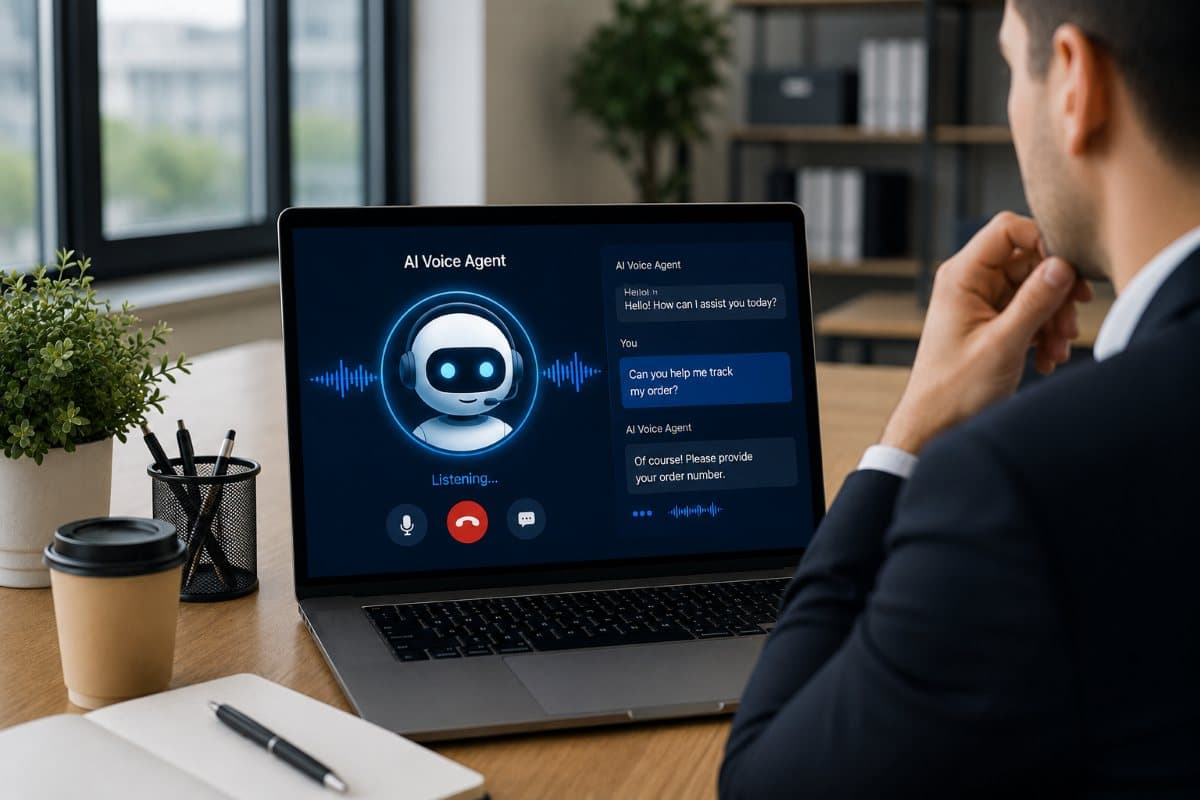
Voice interfaces are changing quickly. Instead of navigating phone menus or typing into chat windows, users can now have natural conversations with AI systems that listen, understand, and respond in real time. These systems are known as AI voice agents, and they're becoming an increasingly common way for businesses to automate customer interactions.
Unlike traditional interactive voice response (IVR) systems that follow fixed scripts, AI voice agents can understand conversational language, respond dynamically, and adapt as a conversation unfolds. They're already being used to answer customer questions, schedule appointments, qualify sales leads, provide technical support, and automate routine tasks that previously required a human agent.
Behind every AI voice agent is a combination of technologies working together. While the conversation may feel seamless, each response depends on several AI models processing speech, language, and audio within fractions of a second.
An AI voice agent is software that can hold spoken conversations with people using artificial intelligence.
Instead of relying on predefined menus or keyword matching, modern voice agents interpret natural speech, understand user intent, generate appropriate responses, and deliver those responses using synthetic speech. The experience is designed to feel conversational rather than transactional.
Although they're often compared to voice assistants, AI voice agents are typically built for specific business workflows. A customer may call to book an appointment, check an order status, report a problem, or ask product questions, with the voice agent handling the interaction from beginning to end or escalating to a human when necessary.
The quality of those conversations depends on far more than the language model alone. Every spoken interaction begins with accurate speech recognition.
While implementations vary, most AI voice agents follow the same sequence of events.
First, the user speaks into a phone, microphone, or connected device. An automatic speech recognition (ASR) system converts that speech into text, with partial results typically returned in a few hundred milliseconds.
The transcript is then passed to a large language model (LLM), which interprets the user's request, considers any available business context, and decides how to respond. Depending on the application, the language model may retrieve information from external systems, access company knowledge bases, or trigger actions such as booking appointments or updating customer records.
Once a response has been generated, a text-to-speech (TTS) system converts the text back into natural-sounding audio, allowing the conversation to continue without interruption.
This entire process repeats continuously throughout the interaction, often fast enough to feel like a normal conversation between two people.
Although AI voice agents appear to be a single product, they're actually built from multiple AI components working together.
Speech recognition converts spoken language into text. This first step is critical because every downstream decision depends on the accuracy of the transcript. If the speech recognition system misunderstands what the user said, the language model is likely to generate an incorrect response.
The large language model provides reasoning and conversation management. It interprets intent, maintains context, generates replies, and determines what actions should be taken during the interaction.
Text-to-speech technology delivers those responses as spoken audio. Modern TTS models generate increasingly natural voices with realistic pacing, pronunciation, and intonation.
Many voice agents also integrate with business systems such as CRM platforms, scheduling software, payment systems, and knowledge bases, allowing them to retrieve information and complete tasks in real time.
Large language models often receive the most attention, but speech recognition is arguably the foundation of every successful voice agent.
Unlike text-based AI systems, voice agents must first understand spoken language before they can generate meaningful responses. That means recognizing different accents, speaking styles, and conversational patterns without delay, and isolating the right speaker when a call comes from a noisy contact center, airport, or household with multiple people talking at once.
A related problem is knowing when someone has actually finished speaking. Basic voice activity detection can't tell the difference between a pause to think and the end of a turn, so it interrupts users mid-sentence. Adaptive turn detection, which reads conversational context rather than just silence, reduces these false interruptions significantly while keeping response times under a second.
Even small transcription errors can change the meaning of a request or cause the conversation to move in the wrong direction. In customer-facing applications, those mistakes quickly affect the overall experience.
For organizations building voice applications, selecting an AI voice agent platform often begins with evaluating the quality, latency, and reliability of its speech recognition capabilities.
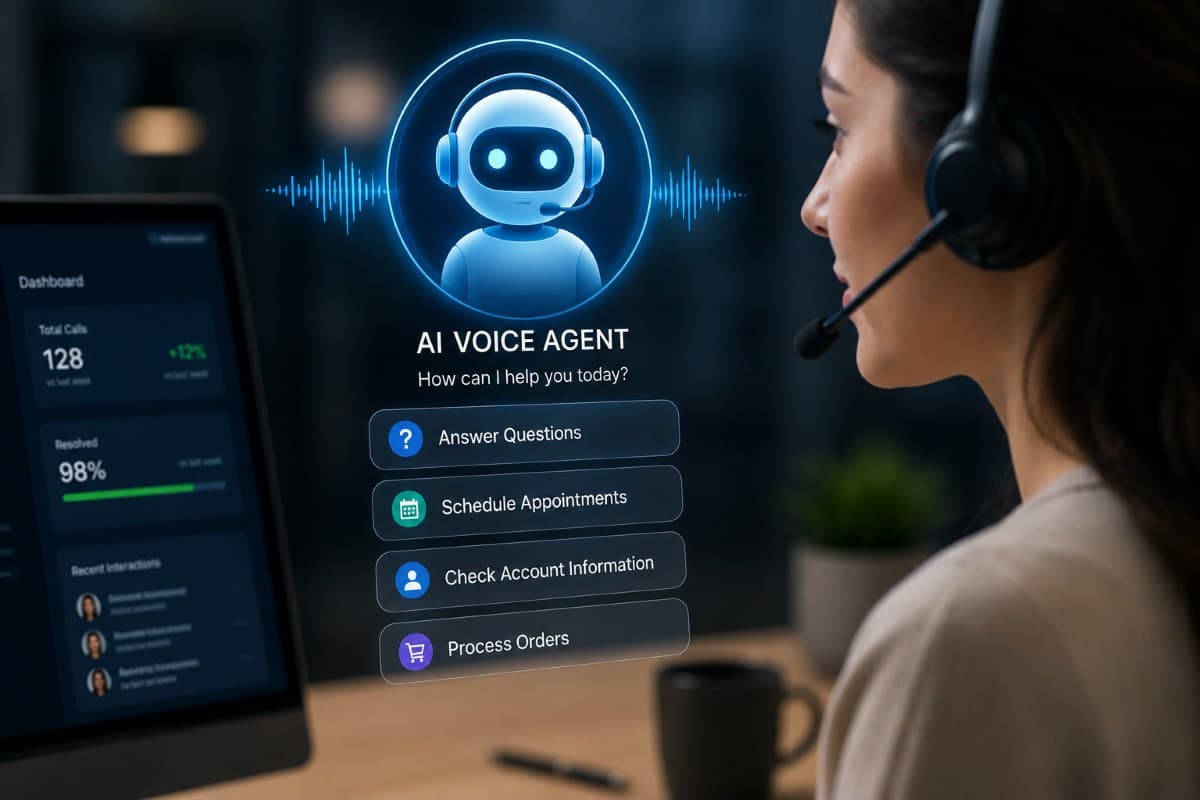
AI voice agents are now being deployed across a wide range of industries.
Customer support teams use them to answer routine questions, verify account information, and resolve common issues before transferring more complex cases to human agents.
Healthcare organizations use voice agents to schedule appointments, collect patient information, and automate administrative workflows.
Retail businesses deploy conversational AI to help customers track orders, answer product questions, and manage returns.
Financial institutions use voice agents to streamline customer service while integrating authentication and compliance processes into the conversation.
In each case, the objective isn't necessarily replacing human agents. Instead, AI handles repetitive, high-volume interactions so people can focus on conversations that require judgment, empathy, or specialized expertise.
Building a reliable voice agent remains technically demanding.
Speech recognition must perform accurately across different accents, languages, recording conditions, and network environments. Language models need to interpret requests correctly while avoiding hallucinations or unsupported answers. Text-to-speech systems must sound natural enough to support comfortable conversations without introducing unnecessary delays.
Latency presents another challenge. Every stage of the pipeline, from transcription to language generation and speech synthesis, adds processing time. If those delays become noticeable, conversations begin to feel unnatural.
Performance can also collapse between testing and production. A voice agent that hits high accuracy on clean test audio can drop sharply once it meets real phone lines, background noise, and crosstalk, conditions that public benchmarks rarely capture.
For that reason, low-latency speech recognition has become one of the defining characteristics of modern voice agent systems.
Voice interfaces are becoming more capable as advances in speech recognition, language models, and speech synthesis continue to reduce friction between people and machines. Future voice agents will handle longer conversations, support more languages, retain context more effectively, and integrate more deeply with business systems.
At the same time, organizations are recognizing that conversational AI is about more than generating convincing responses. The quality of every interaction depends on the entire technology stack, beginning with accurate speech recognition and ending with clear, natural audio.
If you'd like to understand the broader technology behind these systems, our guide to conversational AI explained explores how speech recognition, language models, and voice technologies work together to enable natural conversations between people and AI.




![[alt: Illustration representing multilingual code-switching for the Speechmatics Melia 1 speech-to-text model.]](/_next/image?url=https%3A%2F%2Fimages.ctfassets.net%2Fyze1aysi0225%2F2BgLftzAE6cT0uJczif4Cf%2F805533fa6d54351dddd4a4c1f1ba424e%2FMelia-codeswitching-header.webp&w=3840&q=75)
![[alt: Dark grid background with a circular symbol on the left and a pixelated "K" on the right connected by a cyan line.]](/_next/image?url=https%3A%2F%2Fimages.ctfassets.net%2Fyze1aysi0225%2F24PivVEjmscf5DwtdLPn8P%2F36637a2ef67e1e5b16a1560b3ca524b0%2FLiveKit_Inference-Social-dark.webp&w=3840&q=75)
![[alt: Three blue folders on an orange background, labeled for processing audio files of varying lengths in seconds.]](/_next/image?url=https%3A%2F%2Fimages.ctfassets.net%2Fyze1aysi0225%2F642dhRW3whpEWyQ1OimLTW%2F19aa090e4e0a35f8a0494eb0db84f864%2FMelia-TAT-Social.webp&w=3840&q=75)