
SpeechmaticsEditorial Team
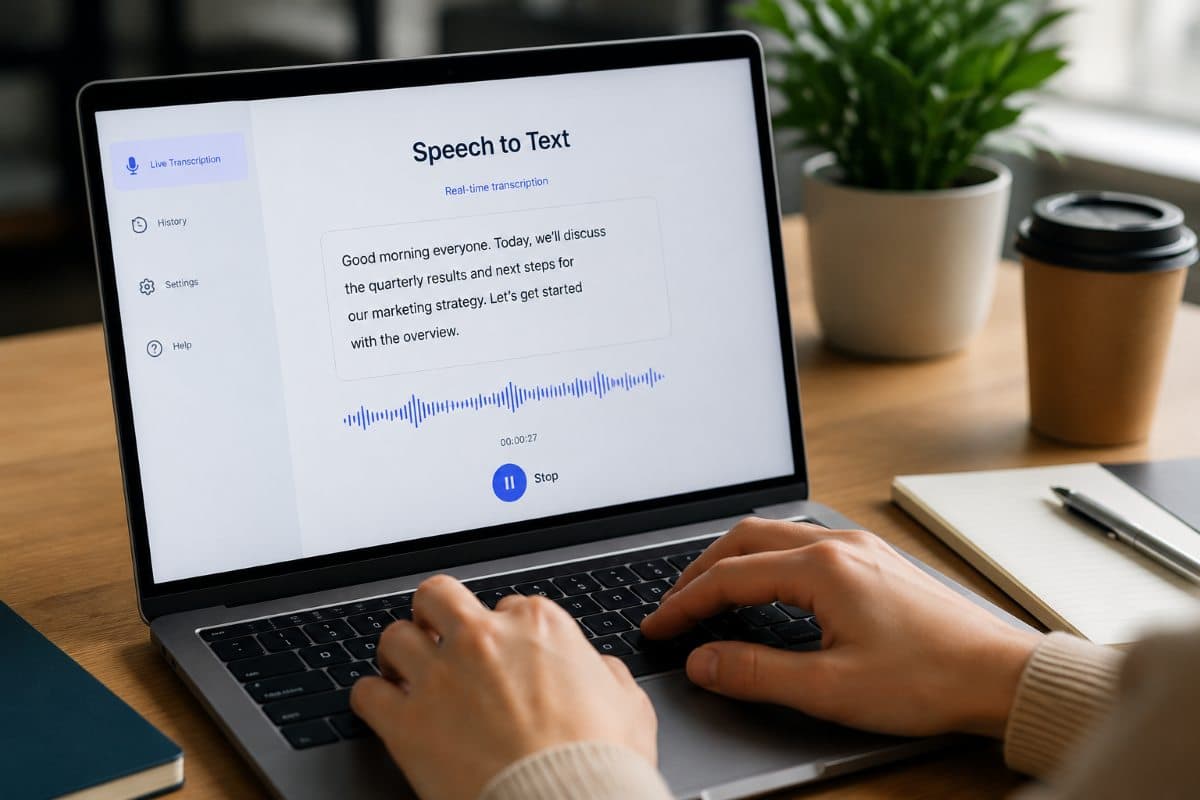
The terms speech-to-text and voice recognition are often used interchangeably, but they solve two very different problems. Both involve artificial intelligence processing human speech, yet their goals are fundamentally different. One focuses on understanding what was said. The other focuses on identifying who said it.
The distinction matters because these technologies are used for different applications, require different types of machine learning models, and present different technical challenges. If you're evaluating AI speech technology for your business, understanding where speech-to-text ends and voice recognition begins is an important first step.
Speech-to-text, also known as automatic speech recognition (ASR), converts spoken language into written text. Its purpose is to recognize words as accurately as possible, regardless of who is speaking.
Modern speech recognition systems are trained on enormous datasets containing millions of examples of human speech. During training, neural networks learn the relationships between sounds, words, grammar, and context, allowing them to generate accurate transcripts from live conversations or recorded audio.
Today, speech-to-text powers everything from live captions and meeting transcription to customer service analytics, clinical documentation, and voice AI applications. As organizations increasingly rely on spoken information, ASR has become a foundational technology for making conversations searchable and actionable.
Voice recognition analyzes the characteristics of a person's voice to determine their identity.
Rather than transcribing speech, voice recognition creates a biometric profile based on features such as vocal tract shape, pitch, cadence, pronunciation patterns, and other acoustic characteristics. That profile can then be compared against stored voiceprints to verify or identify a speaker.
This makes voice recognition useful for applications where identity matters. Banks may use it to authenticate customers over the phone. Secure systems can use it as part of multi-factor authentication, while law enforcement and forensic investigations sometimes use voice comparison techniques as one piece of broader evidence.
The simplest way to distinguish the two technologies is by the question each one answers.
Speech-to-text asks:
What words were spoken?
Voice recognition asks:
Who is speaking?
A speech recognition system should produce the same transcript regardless of whether the speaker is a customer, a doctor, a broadcaster, or a company executive. A voice recognition system, on the other hand, treats those differences as the primary source of information.
Although both technologies analyze audio, they extract different features and optimize for different outcomes.
One common misconception is that speech-to-text works by learning individual voices. Modern ASR systems don't operate that way.
Instead, they're designed to recognize language across as many speakers as possible. The best models are trained using highly diverse datasets that include different accents, dialects, ages, speaking styles, recording conditions, and languages. This diversity allows them to generalize beyond any single speaker and produce consistent transcripts in real-world environments.
That becomes especially important in enterprise settings, where a single organization may serve customers from dozens of countries and language backgrounds. A contact center, healthcare provider, or global media company can't assume every conversation will be recorded under ideal conditions or spoken with the same accent.
This emphasis on broad speech coverage is one reason modern speech recognition has advanced so rapidly over the past decade.
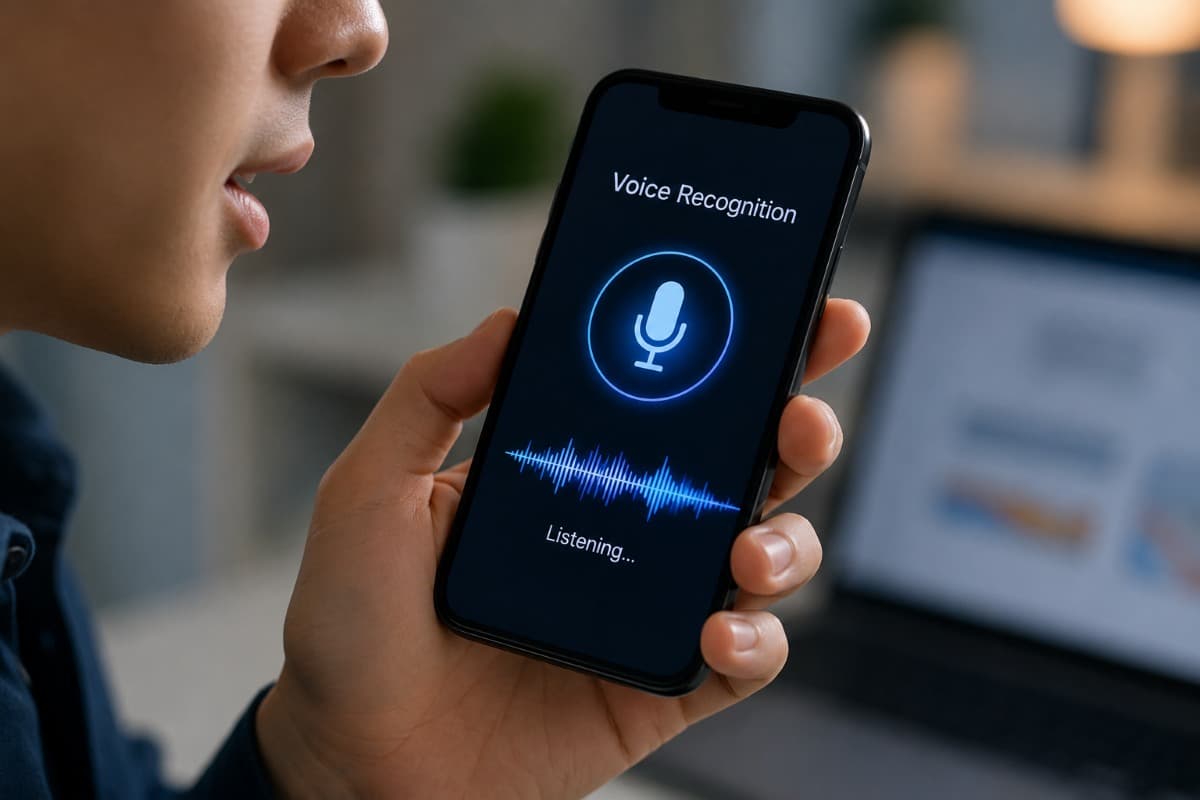
While speech-to-text and voice recognition serve different purposes, they often appear together within the same application.
Consider a customer service call. A speech recognition system transcribes the conversation so it can be searched, analyzed, or summarized. At the same time, a voice recognition system may verify the customer's identity before sensitive account information is discussed.
The two technologies complement each other rather than compete. One extracts language, while the other analyzes identity.
Some enterprise platforms also include speaker diarization, which is different from voice recognition altogether. Speaker diarization separates speakers within a conversation by labeling who is speaking at different points in the transcript, but it doesn't identify those speakers by name or verify their identity.
Voice can also carry signals that go beyond identity or words. Speechmatics' recent partnership with thymia combines speech-to-text with voice biomarker analysis, surfacing health indicators like stress, fatigue, and driver impairment from just 15 seconds of natural speech. That's a third category again: not identifying who is speaking, but reading what their voice reveals about their physical or mental state.
Although voice recognition plays an important role in security and authentication, speech-to-text has become the more broadly adopted technology because spoken language contains enormous amounts of business information.
Organizations use transcripts to monitor customer interactions, generate meeting notes, improve accessibility, automate documentation, and provide structured data for AI systems. Once speech has been converted into text, it can be searched, summarized, translated, analyzed, or combined with large language models to power more advanced workflows.
The rapid growth of conversational AI has accelerated this trend even further. Voice agents, virtual assistants, and real-time transcription services all depend on accurate speech recognition before any downstream AI can generate useful responses.
The right solution depends entirely on the problem you're trying to solve.
If you need to create transcripts, analyze conversations, generate captions, or build conversational AI, speech-to-text is the technology you need.
If your objective is verifying a person's identity based on their voice, voice recognition is the better fit.
Some organizations require both. A financial institution, for example, might authenticate customers using voice biometrics before transcribing the conversation for compliance and quality assurance. In that scenario, each technology performs a distinct role within the same workflow.
As AI models continue to improve, both speech recognition and voice recognition will become more accurate, more efficient, and better suited to real-world conditions. Advances in machine learning are helping speech recognition systems understand a wider range of accents, languages, and recording environments while reducing latency for real-time applications.
Developers can already integrate these capabilities into products using a multilingual speech to text API, allowing applications to transcribe conversations across multiple languages without building speech recognition models from scratch.
If you'd like to explore the technology in more depth, our guide on how speech recognition works explains the core components behind modern ASR systems and why advances in machine learning have transformed speech recognition over the past decade.




![[alt: Illustration representing multilingual code-switching for the Speechmatics Melia 1 speech-to-text model.]](/_next/image?url=https%3A%2F%2Fimages.ctfassets.net%2Fyze1aysi0225%2F2BgLftzAE6cT0uJczif4Cf%2F805533fa6d54351dddd4a4c1f1ba424e%2FMelia-codeswitching-header.webp&w=3840&q=75)
![[alt: Dark grid background with a circular symbol on the left and a pixelated "K" on the right connected by a cyan line.]](/_next/image?url=https%3A%2F%2Fimages.ctfassets.net%2Fyze1aysi0225%2F24PivVEjmscf5DwtdLPn8P%2F36637a2ef67e1e5b16a1560b3ca524b0%2FLiveKit_Inference-Social-dark.webp&w=3840&q=75)
![[alt: Three blue folders on an orange background, labeled for processing audio files of varying lengths in seconds.]](/_next/image?url=https%3A%2F%2Fimages.ctfassets.net%2Fyze1aysi0225%2F642dhRW3whpEWyQ1OimLTW%2F19aa090e4e0a35f8a0494eb0db84f864%2FMelia-TAT-Social.webp&w=3840&q=75)