
SpeechmaticsEditorial Team
Not all speech transcription happens the same way. Some applications need transcripts almost as quickly as words are spoken, while others prioritize accuracy over speed by processing recordings after a conversation has ended. Those two approaches are known as real-time transcription and batch transcription, and each is designed for a different set of use cases.
Understanding the difference is important because transcription isn't simply about converting speech into text. The way audio is processed affects latency, accuracy, infrastructure requirements, and ultimately the experience for both users and developers.
For organizations building AI-powered products or automating speech workflows, choosing the right approach often comes down to a simple question: do you need the transcript immediately, or can it wait?
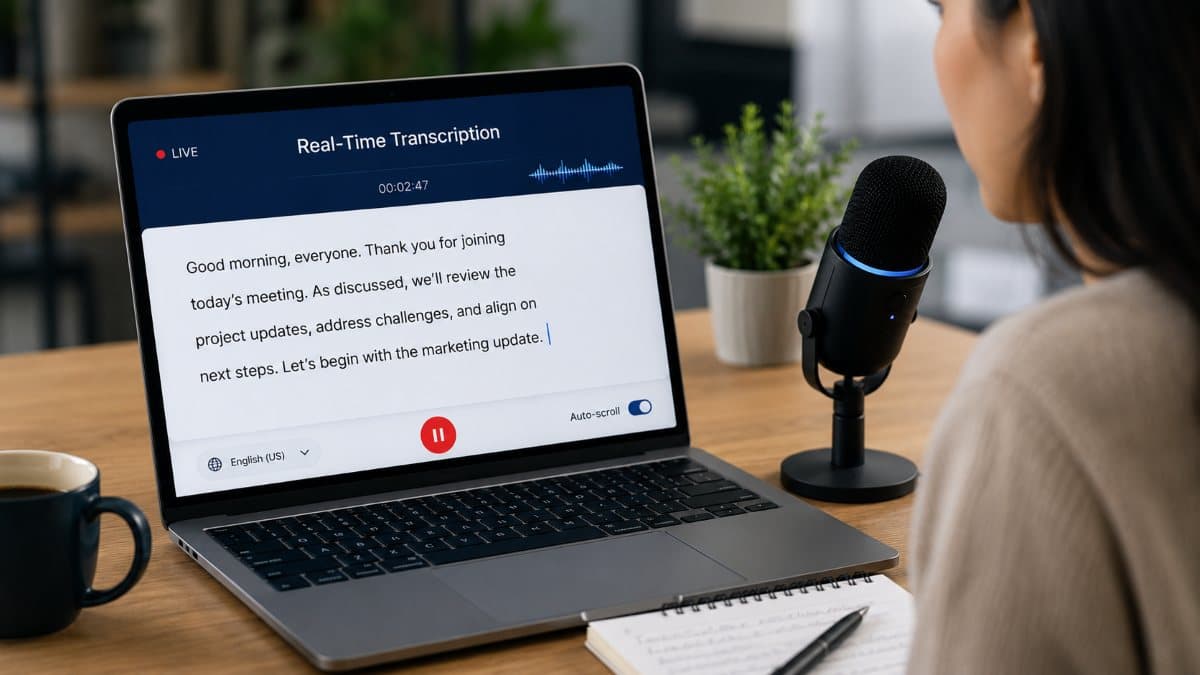
Real-time transcription converts spoken language into text as a conversation is happening. Rather than waiting for the audio to finish, the speech recognition system continuously processes incoming audio streams and generates partial transcripts within milliseconds.
As speakers continue talking, those partial results are refined until the final transcript is complete. Modern speech recognition models are capable of updating text dynamically as additional context becomes available, allowing transcripts to become more accurate as the conversation progresses.
This low-latency approach makes real-time transcription essential for applications where immediate feedback matters. Live captions, voice assistants, customer service platforms, virtual meetings, and conversational AI all depend on transcripts appearing almost instantly.
In these environments, even small delays can interrupt the user experience. The goal isn't simply accurate transcription, but delivering useful text quickly enough to support a live interaction.
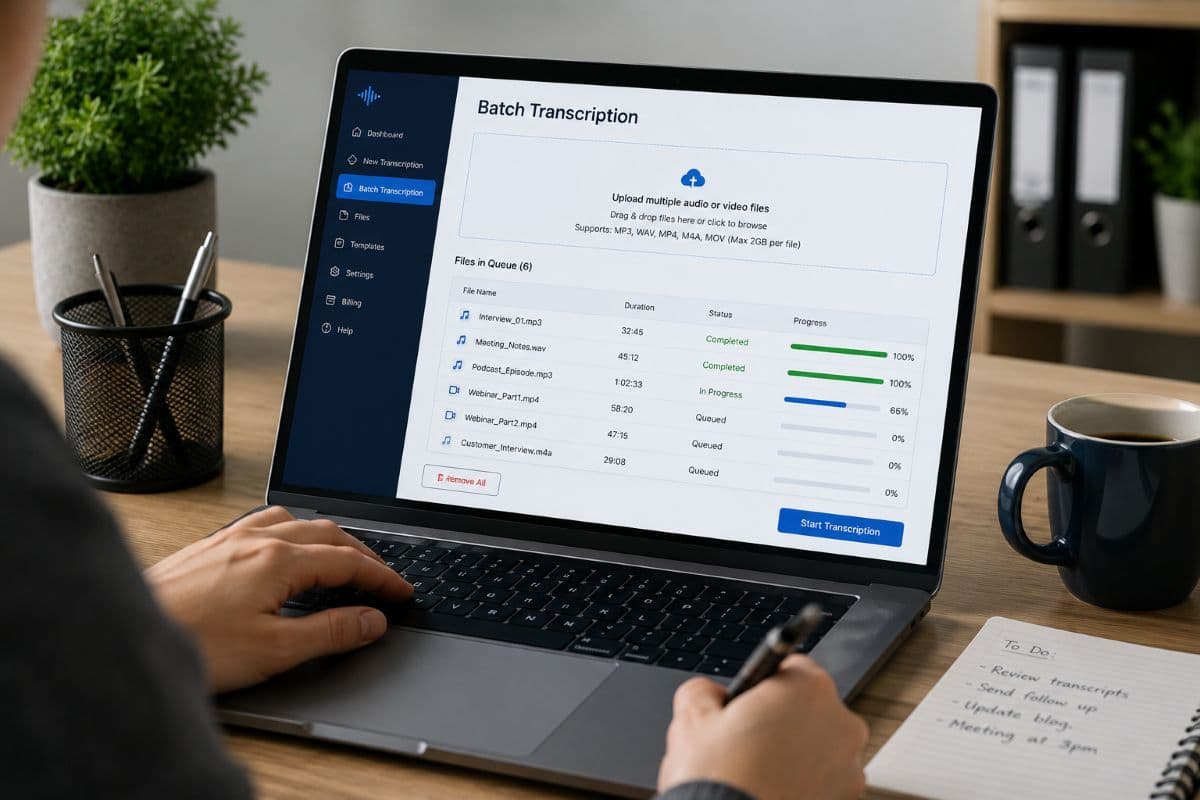
Batch transcription takes a different approach. Instead of processing audio as it's being spoken, the speech recognition system analyzes a completed recording after the conversation has ended.
Because the model has access to the entire recording before generating the transcript, it can evaluate speech with full context. It doesn't need to make immediate predictions while new audio is still arriving, giving it more flexibility to interpret difficult passages, resolve ambiguous words, and produce a polished transcript.
Batch transcription is commonly used for recorded meetings, podcasts, interviews, compliance recordings, medical documentation, broadcast archives, and research projects where turnaround time is less important than transcription quality.
For many organizations, this remains the preferred option whenever live transcription isn't required.
The defining difference between real-time and batch transcription is latency.
Real-time systems are designed to minimize the delay between speech and text. Their performance is measured in milliseconds because transcripts need to keep pace with an active conversation.
Batch transcription doesn't have that constraint. Since the recording is already complete, the system can spend more time analyzing the audio before producing the final transcript.
That distinction influences almost every aspect of how the technology is designed. Real-time models must balance speed with accuracy, while batch models can optimize almost entirely for transcription quality.
Speech recognition becomes easier when the model has access to the entire conversation.
Imagine someone says, "I'll meet you by the bank."
Without additional context, it's impossible to know whether they're referring to a financial institution or the side of a river. As the conversation continues, later sentences often clarify the intended meaning. Batch transcription can use that context because it processes the recording as a whole.
Real-time transcription doesn't have that luxury. It has to make predictions immediately, sometimes before the surrounding context is available. Modern AI models reduce these limitations significantly, but they still operate under stricter timing constraints than batch systems.
For this reason, batch transcription generally achieves slightly higher accuracy, particularly for longer recordings and conversations containing complex vocabulary.
Despite the accuracy advantages of batch processing, many applications simply can't wait until a conversation is over.
Voice agents need immediate transcripts so language models can generate responses naturally. Customer support platforms rely on live transcription to power agent assistance and call analytics while conversations are still in progress. Live captioning services need text to appear almost instantly so viewers can follow along without noticeable delays.
Real-time transcription also enables accessibility tools that help people participate in meetings, lectures, and live events as they happen.
In these scenarios, low latency isn't a bonus feature. It's a core requirement.
Batch transcription is often the better choice whenever recordings don't need to be processed immediately.
Organizations frequently use it to transcribe archived meetings, legal proceedings, medical consultations, podcasts, training videos, interviews, and research recordings. Since users aren't waiting for live results, the system can prioritize transcript quality over processing speed.
Batch workflows can also be more cost-effective for large collections of recorded media because they're typically less demanding than maintaining continuous real-time audio streams.
Many organizations don't choose one approach over the other. They use both.
A contact center, for example, might rely on real-time transcription to provide live agent assistance during customer calls while also running batch transcription afterward to produce a more detailed transcript for quality assurance, analytics, and compliance.
Similarly, a media company may generate live captions during a broadcast before creating a higher-quality transcript for publishing and archiving once the event has ended.
A third option sits between the two.
Micro-batching splits audio into short chunks, typically 25 to 35 seconds, and submits each as its own batch job, stitching the results together downstream. It avoids the persistent connection real-time transcription requires, while still returning a transcript within seconds rather than minutes. This is common in medical scribe applications and voice-agent post-call summaries, where a few seconds of latency is acceptable but a live word-by-word feed isn't necessary.
Each of these approaches aren't competing technologies, rather they're designed for different stages of the same workflow, making the choice of approach a nuanced decision.
Advances in AI have made both real-time and batch transcription significantly more accurate than previous generations of speech recognition. Deep learning models now recognize natural conversation across a wider range of accents, recording conditions, and languages while producing transcripts quickly enough for enterprise applications.
Developers can access these capabilities through a transcription API platform, allowing speech recognition to be integrated directly into products without building and maintaining complex ASR infrastructure. Modern APIs typically support both streaming and batch processing, making it possible to choose the right mode for each use case while working within a single platform.
The answer depends entirely on what you're trying to achieve.
If users need to see text while someone is speaking, real-time transcription is the right solution. If the objective is producing the most accurate transcript possible from recorded audio, batch transcription will often deliver better results.
Many organizations ultimately benefit from using both. Real-time transcription supports live experiences, while batch transcription creates richer records for analysis, search, compliance, and long-term storage.
If you're evaluating live speech applications, our guide to the benefits of real-time speech technology explores why low-latency transcription has become a critical building block for conversational AI, accessibility, and customer engagement.




![[alt: Illustration representing multilingual code-switching for the Speechmatics Melia 1 speech-to-text model.]](/_next/image?url=https%3A%2F%2Fimages.ctfassets.net%2Fyze1aysi0225%2F2BgLftzAE6cT0uJczif4Cf%2F805533fa6d54351dddd4a4c1f1ba424e%2FMelia-codeswitching-header.webp&w=3840&q=75)
![[alt: Dark grid background with a circular symbol on the left and a pixelated "K" on the right connected by a cyan line.]](/_next/image?url=https%3A%2F%2Fimages.ctfassets.net%2Fyze1aysi0225%2F24PivVEjmscf5DwtdLPn8P%2F36637a2ef67e1e5b16a1560b3ca524b0%2FLiveKit_Inference-Social-dark.webp&w=3840&q=75)
![[alt: Three blue folders on an orange background, labeled for processing audio files of varying lengths in seconds.]](/_next/image?url=https%3A%2F%2Fimages.ctfassets.net%2Fyze1aysi0225%2F642dhRW3whpEWyQ1OimLTW%2F19aa090e4e0a35f8a0494eb0db84f864%2FMelia-TAT-Social.webp&w=3840&q=75)