
SpeechmaticsEditorial Team
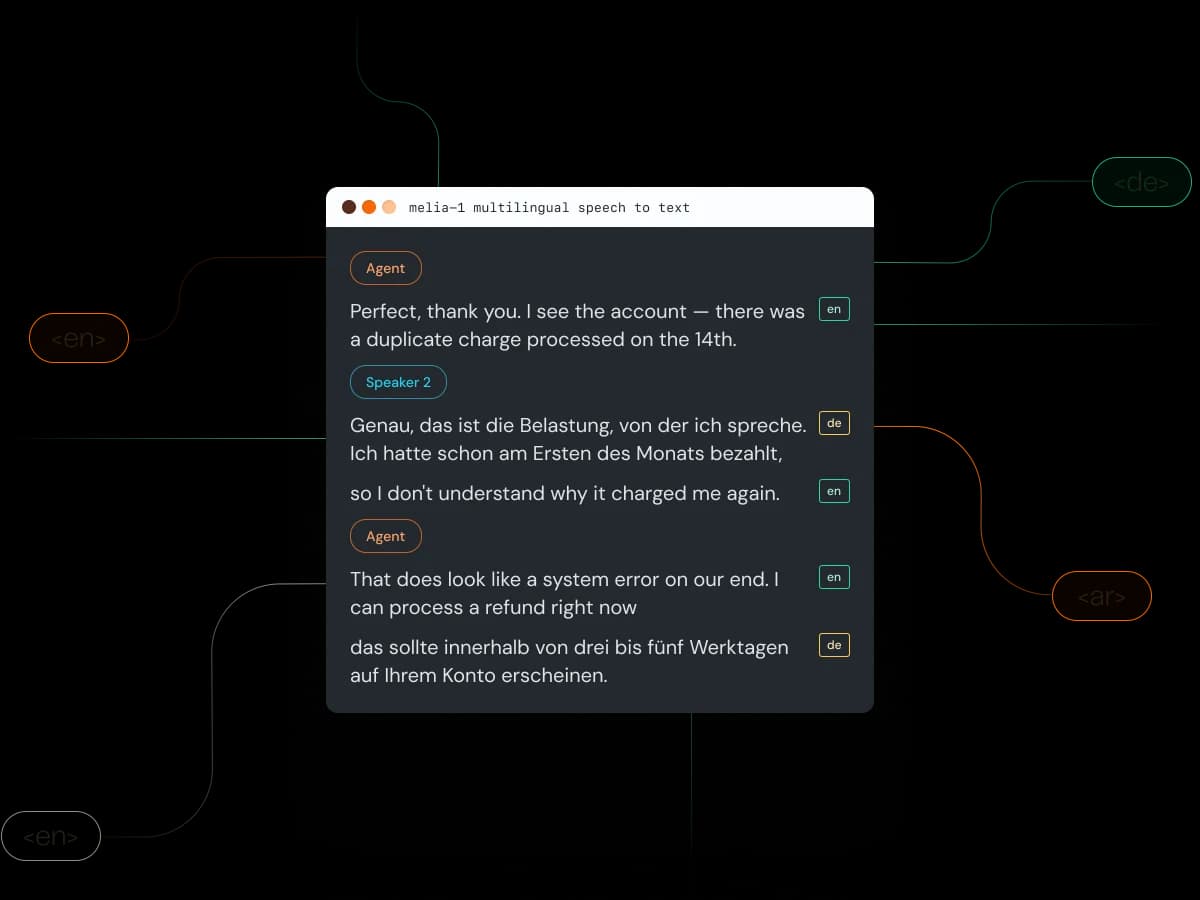
Code-switching is what happens when a speaker changes language mid-sentence. Melia 1, our multilingual speech-to-text model, launched in June, and since then the work has gone into pushing its code-switching accuracy further.
Most of the world doesn't speak one language at a time, and anything built on speech recognition inherits the problem. South East Asia and the Middle East are both hubs for global industries that record their calls, such as finance, insurance, shipping and commodities, and both run on a workforce that changes language mid-sentence. A contact center in Singapore needs transcripts that hold English, Mandarin, Malay and Tamil across its calls. A team in Abu Dhabi works in Arabic and reaches for English technical terms, and a summary that quietly drops them is worse than no summary. The language switches are often only a few words long, which is what makes them easy to miss.
Speech models fail on this in three ways. Some never switch, picking one language and carrying it through everything else, transcribing the rest phonetically or dropping it. Some switch when the speaker didn't. Some switch a word or two after the speaker did. Each one leaves a transcript that reads as though part of the conversation never happened.
Mixed error rate is the share of words a model gets wrong: substituted, deleted or inserted. A rate of 12% means roughly 12 errors per 100 words. Lower is better. It's called mixed because languages written without spaces between words, like Mandarin, are scored on characters rather than words, and the two are combined into one figure.
Switch point F1 is narrower. At each point where the speaker changes language, did the model change too? It scores both halves of the problem: whether the model found the changes that happened, and whether the changes it made were real. Transitions only, on a scale of 0 to 1. Higher is better.
The second metric exists because the first can't tell you how well a model captures the switches. Mixed error rate weights every word equally, so a language that occupies a tenth of a file contributes a tenth of the score, however much that tenth matters to whoever reads the transcript. Switch point F1 counts every transition equally, however short the segment, so switching ability shows up in the number instead of being averaged away.

Mixed error rate, %. Lower is better. Speechmatics internal evaluation, no language hints.
Melia 1 has the lowest mixed error rate of any model tested on Arabic and English code-switching, at 15.1% against 33.2% for the next best. Tamil and English follows a similar pattern, 28.4% against 48.8%. Mandarin and English is closer, but Melia 1 still comes out ahead.
Mixed error rate tells you how much a model got wrong. Switch point F1 tells you whether it was following the language change at all.

Reference-weighted across Mandarin, Tamil and Arabic paired with English. Higher is better.
Melia 1 has the highest switch point F1 of any model tested, at 0.714 across Mandarin, Tamil and Arabic paired with English. On Mandarin and Tamil alone it rises to 0.928, and Melia 1 leads on both.
Tamil and English is the clearest case: Melia 1 has the lowest mixed error rate there and the cleanest switching. It recognizes both languages accurately and follows the speaker between them. Plenty of models manage one without the other.
Switch point F1 identifies the output language from character sets rather than from vendor language labels, so one method applies to every model. Malay and English share the Latin alphabet, so that pair can't be scored this way, which is why the average covers three pairs rather than four.
Alongside the code-switching work, Melia 1 has also improved at handling alphanumeric strings: reference numbers, postcodes, product codes, card numbers, anything mixing letters and digits. Those gains apply to every language Melia 1 supports, not just the pairs above. They matter wherever a mis-transcribed number costs more than a mis-transcribed adjective, whether that's a reference number on a support call or a dosage in a clinical note.
Batch turnaround has come down sharply. Melia 1 is now among the fastest models available: a 60-minute recording transcribed in under 20 seconds, a 30-minute file in under 10 seconds, a 10-minute file in under 5 seconds. That matters most when you're working through a backlog rather than a single file, where turnaround compounds across every job in the queue.
The same work moves next to Latin America and the US Hispanic market, where English and Spanish mixing is routine, and to the Indic languages of South Asia. General accuracy keeps improving across every language Melia 1 supports, code-switched or not.






![[alt: Dark grid background with a circular symbol on the left and a pixelated "K" on the right connected by a cyan line.]](/_next/image?url=https%3A%2F%2Fimages.ctfassets.net%2Fyze1aysi0225%2F24PivVEjmscf5DwtdLPn8P%2F36637a2ef67e1e5b16a1560b3ca524b0%2FLiveKit_Inference-Social-dark.webp&w=3840&q=75)
![[alt: Three blue folders on an orange background, labeled for processing audio files of varying lengths in seconds.]](/_next/image?url=https%3A%2F%2Fimages.ctfassets.net%2Fyze1aysi0225%2F642dhRW3whpEWyQ1OimLTW%2F19aa090e4e0a35f8a0494eb0db84f864%2FMelia-TAT-Social.webp&w=3840&q=75)