SpeechmaticsEditorial Team
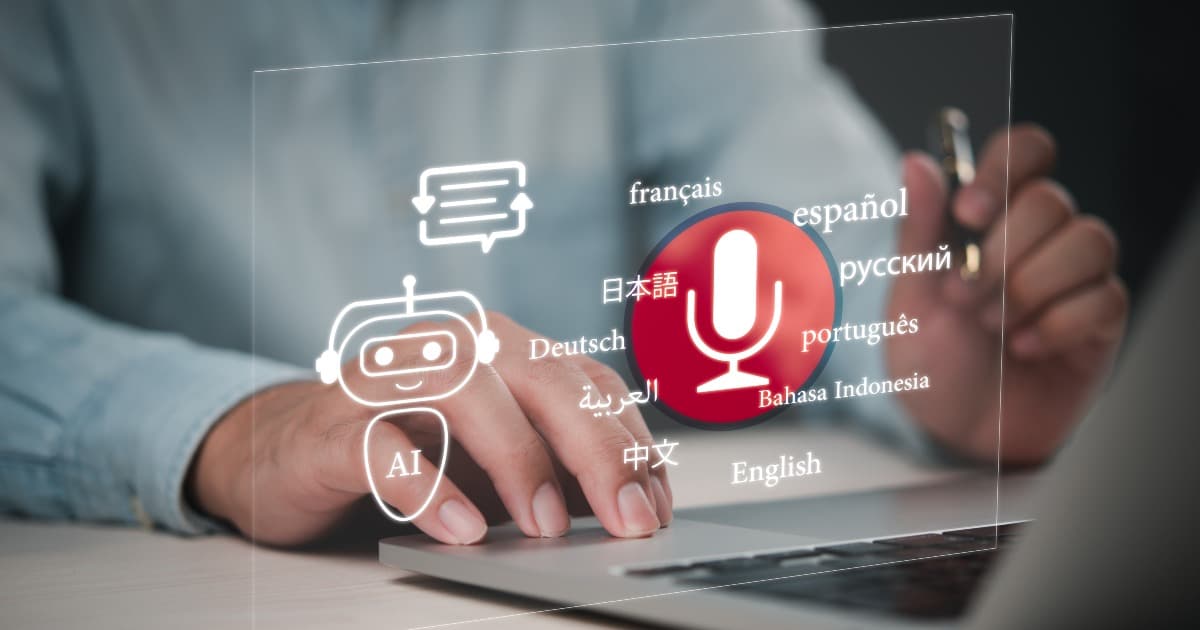
People do not always stay in one language when they speak. In many homes, workplaces, hospitals, and contact centers, speakers naturally move between two languages in the same conversation. Sometimes they switch between sentences. Sometimes they switch in the middle of a sentence. This is called code-switching.
For speech AI, code-switching is a real challenge. Many older speech recognition systems were built to handle one language at a time. That works well when a speaker stays fully in English, Spanish, or Arabic. It works far less well when a person mixes languages naturally.
That is why code-switching has become a major focus in modern speech technology. As global platforms serve more multilingual users, speech AI needs to recognize language shifts without losing accuracy, context, or speed.
Code-switching happens when a speaker alternates between two or more languages during a conversation. This can happen for many reasons. A person may use the clearest word for the moment, reflect the way their community speaks, or switch terms because one language is more natural for technical, medical, or business vocabulary.
In practice, this is common in multilingual regions and teams. A doctor may explain most of a consultation in one language, then say a drug name in English. A customer service agent may greet a caller in one language and solve the problem using a mix of both. A family may move between languages without even noticing.
This matters because speech AI must process the way people actually talk, not the way a clean textbook example sounds.
Traditional speech recognition systems often depend on a language model and an acoustic model that are tuned for one language. When a speaker suddenly switches languages, the system may mishear the word, drop it completely, or force it into the wrong language pattern. That can lead to bad transcripts, wrong speaker intent, and poor downstream results.
General speech recognition guidance explains that code-switching is difficult because the system has to identify not only the words being said, but also the language being used at each moment. Modern systems address this through language detection and multilingual acoustic modeling so they can handle language boundaries more smoothly.
The challenge grows when other real-world conditions are added. Accents, fast speech, overlapping speakers, background noise, and domain-specific terms all make recognition harder. If a platform supports customers across countries and languages, the system cannot treat code-switching as an edge case. It has to treat it as normal speech.
Modern speech AI handles code-switching by combining multilingual training, language-aware modeling, and real-time recognition that can adapt as speech unfolds.
Instead of forcing the whole conversation into one language, stronger systems are trained on multilingual data and mixed-language examples. This helps the model learn how real speakers move between languages. It can recognize that one phrase belongs to one language, while the next word belongs to another, without breaking the transcript.
Speech recognition systems that handle code-switching well often use multilingual acoustic models along with language detection. This lets the system identify phonetic and contextual cues, then switch recognition behavior as needed.
On top of that, enterprise speech AI also needs supporting features like speaker diarization, punctuation, timestamps, and domain vocabulary handling. These features matter because a transcript is not useful if it captures the words but loses who said them, where they were said, or what specialized terms meant in context.
This is where bilingual and multilingual models make a major difference. A single model that can understand both languages together is often more effective than stitching together separate monolingual models.
Speechmatics recently launched an Arabic-English bilingual model designed to handle Arabic dialects and English simultaneously, including real-world code-switching. The company says the model achieved 35% lower word error rate than Google on Arabic-English code-switching tasks, with 6.3% versus 9.7% on those benchmarks.
That matters because code-switching is especially common in markets where English terms are mixed into local-language speech. In the same announcement, Speechmatics explained that this is normal in healthcare, contact centers, and finance across MENA, where speakers may move between Arabic and English within the same sentence. This is also why businesses looking for stronger bilingual speech recognition need to think beyond simple language coverage. The question is not only whether a provider supports both languages separately. It is whether the model can handle them together in a natural conversation.
Code-switching support is valuable in many environments, but it becomes especially important when accuracy has operational or compliance impact.
In healthcare, clinicians may switch between a local language and English medical terms, drug names, dosages, or shorthand. Speechmatics says its Arabic-English bilingual medical model was trained on both English and Arabic clinical terminology and built to transcribe mixed-language clinical speech more accurately.
In contact centers, customers often speak the way they do in everyday life. They may not stay neatly inside one language. If the system fails when a caller switches mid-sentence, customer experience suffers.
In voice agents, multilingual support now matters at platform level too. Speechmatics says its speech-to-text technology supports 56+ languages and is built for code-switching, where speakers move between languages naturally during conversation.
In legal, media, and meeting workflows, code-switching can also affect transcript search, record accuracy, and speaker attribution. The better the AI handles the switch, the more useful the transcript becomes downstream.
Handling code-switching is not only about model quality. It is also about deployment fit.
Many organizations operating in regulated or privacy-sensitive environments cannot send all voice data to a public cloud. Speechmatics states that its technology can be deployed in cloud SaaS, on-premises, and on-device environments, with support for real-time and batch transcription. The company also highlights secure deployment options, no data logging as standard, and enterprise compliance support for use cases where privacy matters.
That flexibility matters because multilingual speech often appears in sensitive settings like hospitals, customer support, and legal workflows. A strong model is only useful if it can be deployed where the business needs it.
If your users speak more than one language, code-switching should be part of your evaluation from the start. Do not assume a provider that supports many languages automatically handles mixed-language speech well.
Look for evidence that the model can process code-switched conversations in real conditions. Check whether it supports dialect variation, speaker diarization, real-time use, and domain terminology. Ask whether the same model works across live and batch workflows. And make sure the deployment options fit your privacy, latency, and governance needs.
The goal is simple. Speech AI should follow the conversation as people actually speak, not force them to sound more machine-friendly.
Code-switching is not a niche behavior. For millions of speakers, it is normal conversation. That means speech AI has to do more than recognize one language well. It has to track language shifts, preserve meaning, and stay accurate in real-world environments.
The strongest systems do this through multilingual and bilingual modeling, language-aware recognition, and enterprise-ready deployment choices. For businesses building voice products, customer service workflows, or transcription tools, that is the difference between a demo that works in perfect conditions and automatic transcription software that works where people really talk.


![[alt: Healthcare is a strain image]](/_next/image?url=https%3A%2F%2Fimages.ctfassets.net%2Fyze1aysi0225%2F4YLB294PotEnVZFTtksUt8%2F0f9e81fbe24027f52d1941713e032217%2Fmedical_blog_header_general_01.webp&w=3840&q=75)