
SpeechmaticsEditorial Team
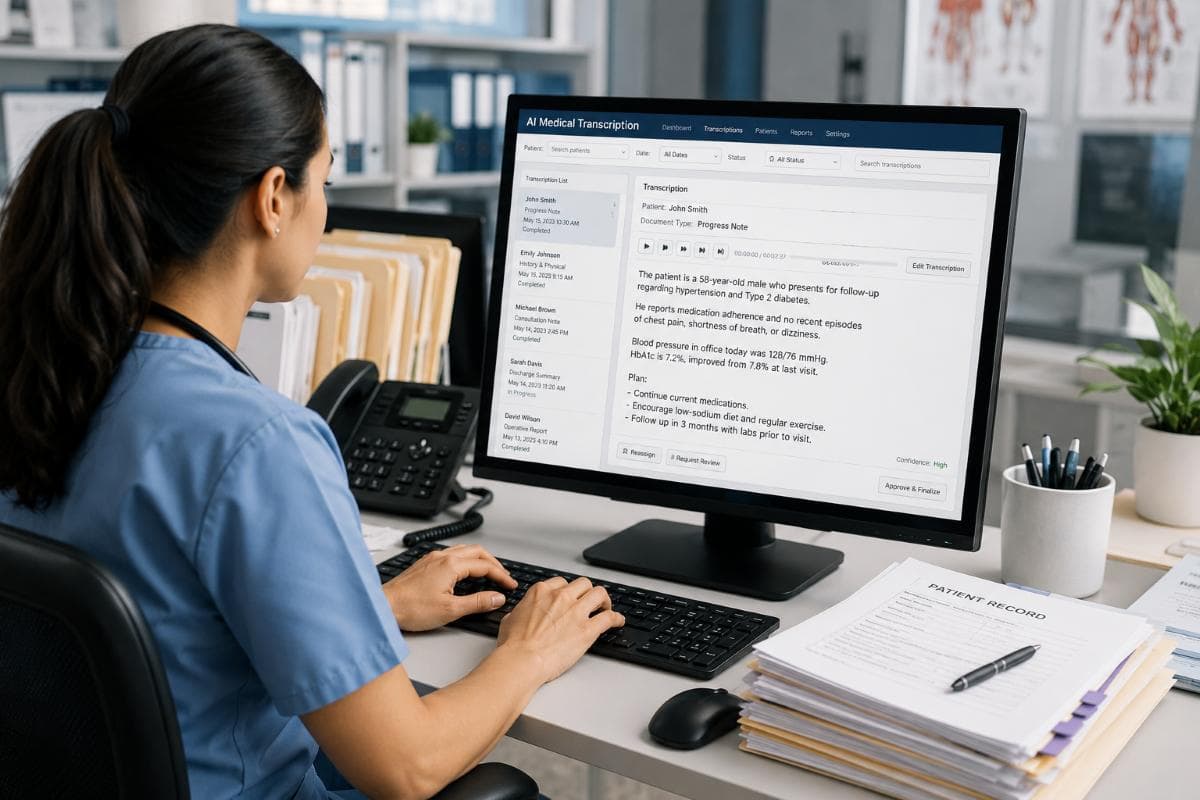
Clinical documentation has a way of swallowing time that nobody thought they were signing up for.
The patient visit might take 15 minutes. The note can linger for far longer. Multiply that across a day of consultations, follow-ups, referrals, handoffs, and compliance requirements, and the real burden becomes obvious. The job is not just care. It is care plus documentation, plus system navigation, plus the after-hours admin that quietly spills into evenings.
That is why AI medical transcription matters in 2026. Not because it is fashionable to add AI to healthcare software, but because clinical workflows are still under strain, and documentation sits near the center of the problem.
Done well, AI medical transcription helps clinicians capture what happened in the room without turning every encounter into a typing exercise. Done badly, it creates another layer of noise, risk, and review work. So the useful question is not whether AI can transcribe medical speech. It can. The real question is what kind of system actually works inside clinical workflows where accuracy, speed, privacy, and trust all matter at once.
At its simplest, AI medical transcription converts spoken clinical language into written documentation.
That can include dictated notes, doctor-patient conversations, therapy sessions, discharge instructions, radiology observations, care coordination calls, and more. The system listens to speech, turns it into text, and in many cases structures that text into something closer to usable clinical documentation.
In 2026, the category is broader than old transcription software and more useful than basic dictation tools. Modern systems do not just capture words. They can add punctuation, separate speakers, recognize medical terminology, generate structured summaries, and feed drafts into the EHR workflow.
That is where the gap between generic transcription and clinical transcription becomes obvious. Healthcare speech is full of specialist language, abbreviations, medication names, hesitations, interruptions, and context that changes the meaning of a phrase very quickly. A system built for podcasts or meetings may transcribe some of it. A system built for clinical work has to do more than keep up. It has to stay dependable when the stakes are higher.
That need for dependability is exactly why healthcare has become one of the clearest real-world uses for speech AI.
Clinicians are still spending too much time documenting care. In the workspace material on AI medical transcription and ambient AI, the recurring pattern is not subtle: documentation eats into patient time, pushes admin into evenings, and contributes directly to burnout. AI medical transcription is attractive because it targets one of the most disliked parts of the workflow without asking clinicians to relearn how to speak or practice medicine.
It also fits the direction of care delivery more broadly. Healthcare systems want cleaner records, faster turnaround, better continuity, and less clerical drag. Clinicians want to stay present with patients. Operations teams want efficiency without adding headcount. Compliance teams want a clear story on privacy, retention, and auditability. Medical transcription sits where all of those pressures meet.
So adoption is not being driven by novelty. It is being driven by workflow pain.
Once you move from the category label to the actual system, the workflow is fairly easy to describe.
Audio comes from a live consultation, a dictated note, a virtual visit, a phone call, or a recorded interaction. The speech engine processes that audio, recognizes the spoken language, and returns text. In healthcare settings, the stronger systems then add structure: punctuation, timestamps, speaker labels, and in some cases sectioned summaries or note drafts.
The technical steps under the hood usually include:
Audio capture from a microphone, mobile device, room setup, or telehealth session
Speech recognition tuned for clinical terminology and natural conversation
Speaker diarization where more than one person is involved
Language and context modeling to resolve ambiguous phrases
Formatting into usable clinical output, often with note-ready structure
Review and sign-off by the clinician before final entry into the record
That final step matters. In clinical environments, transcription is not the same as autonomous documentation. A good system reduces manual work. It does not erase the need for clinical judgment.
This is also where medical transcription in 2026 starts to look very different from the older model.
Traditional medical dictation required active effort. The clinician had to stop, dictate, format, and often revisit the result later. Ambient systems changed that by moving transcription into the background.
Instead of asking the clinician to create a separate documentation moment, ambient transcription captures the natural conversation during care. The interaction keeps moving. The transcript becomes a draft note, not a separate task waiting at the end of the day.
That shift matters because it changes the ergonomics of documentation. The benefit is not only speed. It is fewer workflow interruptions, less context switching, and a better chance that the clinician stays focused on the patient instead of the screen.
This is one reason ambient AI and medical scribes now show up so often in discussions of healthcare speech technology. They are not just another transcription feature. They represent a different operating model.
Once ambient and structured transcription are on the table, the use cases spread quickly across the care environment.
In primary care, AI medical transcription is often used to capture the consultation, generate a draft SOAP note, and reduce the amount of documentation left after the visit. That is the workflow most people now associate with AI scribes, and for good reason: it targets a high-volume setting where admin burden is constant.
Therapy and counseling sessions create a different kind of documentation challenge. The value here is not just speed. It is presence. If the clinician is scribbling notes through a sensitive session, the interaction changes. Ambient transcription can help preserve attention while still producing structured progress notes afterward.
In emergency settings, everything gets messier: more interruptions, more background noise, faster handoffs, and more than one speaker in play. That makes transcription harder, but also more useful. Capturing details in a high-pressure environment can improve the completeness of records and reduce the need to reconstruct events later.
Specialists often work with dense terminology, fast interpretation, and repeatable documentation patterns. In radiology, for example, voice-driven reporting has obvious value when the speech model can reliably handle domain language. The same is true in other specialties where terminology accuracy is not a nice extra.
Transcription is also useful outside the live encounter. Follow-up calls, care coordination, discharge communication, and post-op recovery check-ins all generate spoken information that needs to be recorded, searched, or routed onward.
Taken together, these settings show the same pattern: wherever spoken clinical information needs to become usable documentation, AI medical transcription has a role.
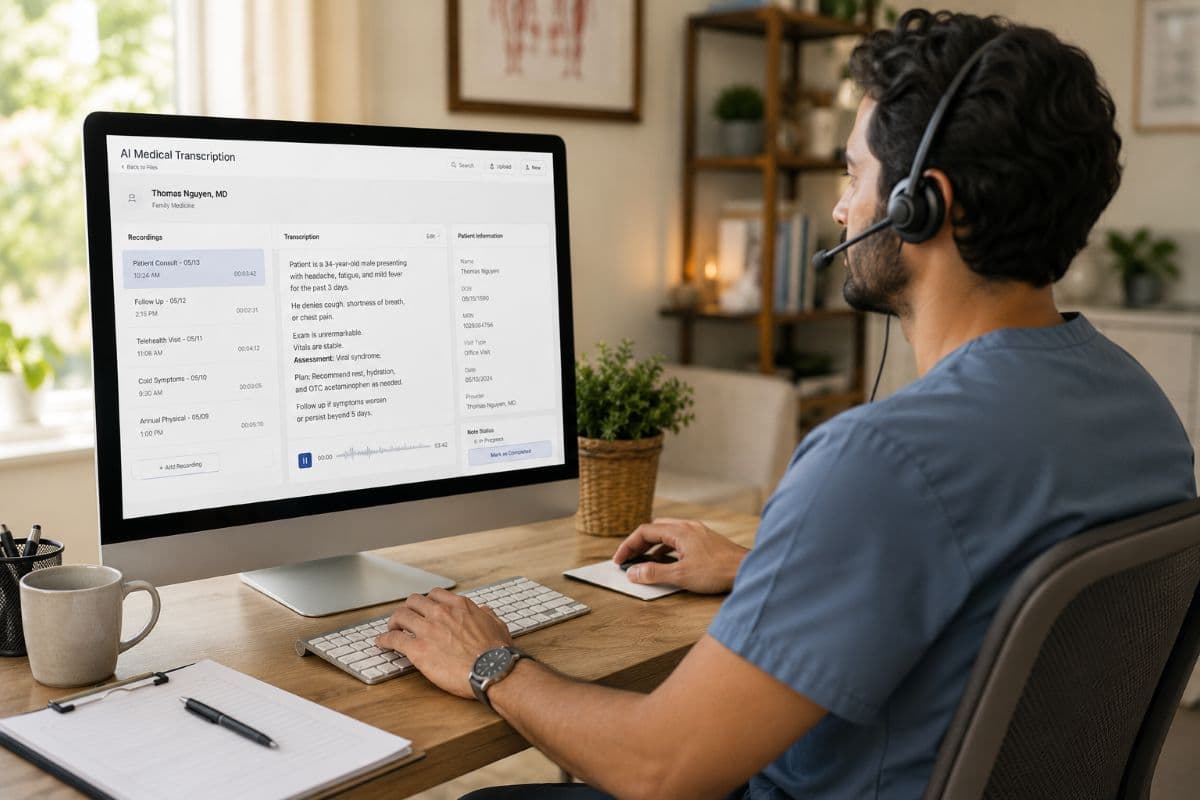
That role depends heavily on the difference between clinical-grade tools and generic speech recognition.
A general-purpose model may handle plain language reasonably well, but clinical environments expose weaknesses quickly. The challenge is not just hearing the words. It is hearing the right words, in the right context, with the right formatting, under conditions that are rarely clean.
The stronger medical transcription systems tend to stand out in a few areas:
Better recognition of medical terminology, medications, acronyms, and specialty language
Stronger performance in conversational, multi-speaker clinical audio
More useful output structure for notes and records
Integration with existing healthcare documentation workflows
Clearer controls around privacy, storage, and access
This is where providers with serious speech infrastructure start to matter. If you are evaluating platforms built for real-world speech performance rather than just tidy demos, Speechmatics is one example worth looking at.
That performance question leads to the biggest practical issue in the category: accuracy.
Healthcare teams do not care about speech AI in the abstract. They care whether the note is right.
A transcription error in a casual meeting may be annoying. In a clinical workflow, it can be much more consequential. Wrong medication names, misheard symptoms, incorrect speaker attribution, or dropped details create friction at best and risk at worst. Even when errors are caught, too many of them erase the time savings because the clinician ends up reviewing everything line by line.
So accuracy has to be evaluated in the conditions that actually matter:
Medical terminology and abbreviations
Different accents and speaking styles
Background noise and interruptions
Fast conversational turn-taking
Multiple speakers
Telehealth and phone-quality audio
Different specialties, each with their own vocabulary
This is why medical models and healthcare-specific tuning matter. A model that performs well on general business audio is not automatically ready for clinical work.
Once accuracy is in place, the next question is speed.
Real-time transcription is useful because it supports note generation during the encounter rather than after it. That can reduce lag between care and documentation, and it can make the review step faster because the draft is already there.
Still, speed alone is not enough. A fast system that creates awkward review work is not really helping. In clinical workflows, the better question is whether the tool fits naturally into how documentation already happens.
That includes:
How much editing the clinician has to do
Whether output maps cleanly to note structures like SOAP
How easily the draft moves into the EHR n- Whether the system interrupts the encounter or fades into the background
How much onboarding and habit change it requires
A lot of healthcare technology fails here. The feature works. The workflow does not.
That mismatch becomes even more expensive when privacy concerns enter the picture.
Medical transcription systems handle some of the most sensitive data any speech product will touch. Audio may contain diagnoses, medications, family history, mental health information, and personally identifiable details. So deployment cannot be treated like a standard software add-on.
In practical terms, healthcare buyers need clear answers on:
HIPAA and other relevant compliance requirements
Encryption in transit and at rest
Data retention policies
Access controls and auditability
Whether audio is used for model training
Regional or on-premise deployment options where needed
Consent and governance practices around always-listening systems
This is one reason trust becomes part of product quality. If clinicians or patients are uneasy about how the system listens, stores, or shares data, the workflow advantage starts to disappear.
By this point, the pattern should feel familiar. The hard part is rarely the initial demo.
The hard part is making the tool live comfortably inside the rest of the stack.
Healthcare organizations do not just need transcription output. They need that output to land in real systems, support real documentation patterns, and survive contact with IT, compliance, procurement, and clinician habits. EHR integration matters. Template compatibility matters. Review workflows matter. Change management matters.
This is why a promising pilot can still stall. The speech engine may be strong, but if deployment is clumsy or the compliance story is vague, the organization slows down. In practice, successful adoption usually depends on three things happening together:
Clinicians trust the output enough to use it
Operations teams can defend the efficiency case
Security and compliance teams can approve the setup without guesswork
When one of those pieces is missing, scale gets harder.
So if you are choosing an AI medical transcription system now, what should you actually look at?
Start with the basics, but test them in clinical reality rather than procurement language.
Use real samples from your environment. Include specialty terms, different accents, interruptions, telehealth audio, and fast back-and-forth conversation. If the system only looks good on polished sample clips, it is not ready.
Look at how the tool fits into the visit, the note review process, and the EHR. The best systems remove friction instead of moving it somewhere else.
Check whether the transcript is just raw text or something closer to usable documentation. Punctuation, diarization, timestamps, note sections, and specialty-specific formatting all affect the amount of cleanup left to the clinician.
Understand where the data goes, how long it stays there, and what controls your organization has. This is often where enterprise healthcare decisions are really made.
The tool has to work for one clinician, but it also has to make sense across departments, sites, or health systems. That means looking beyond the pilot and understanding the operating model at scale.
As the category matures, it helps to be precise about what AI medical transcription is for.
The goal is not to replace clinicians. It is not to automate judgment. It is not to turn the encounter into a machine-managed process.
The goal is simpler than that. It is to reduce documentation drag so clinicians can spend more of their attention where it belongs, while healthcare organizations get cleaner, more usable records.
That is why AI medical transcription has become one of the most practical speech AI categories in healthcare. The value is concrete. It saves time, reduces clerical burden, improves the flow of documentation, and supports better continuity of information across care.
In 2026, that is enough to matter.
The cleanest way to judge any medical transcription system is not by how futuristic it sounds. It is by what happens at the end of the day.
If clinicians are still finishing notes late into the evening, still correcting the same kinds of errors, and still working around the tool instead of with it, the technology has not solved much.
If the system captures the encounter accurately, fits the workflow, protects patient data, and gives clinicians real time back, then it is doing the job.
That is the standard worth using. Not whether the product can transcribe medical speech in a demo, but whether it can survive the realities of clinical work.




![[alt: Illustration representing multilingual code-switching for the Speechmatics Melia 1 speech-to-text model.]](/_next/image?url=https%3A%2F%2Fimages.ctfassets.net%2Fyze1aysi0225%2F2BgLftzAE6cT0uJczif4Cf%2F805533fa6d54351dddd4a4c1f1ba424e%2FMelia-codeswitching-header.webp&w=3840&q=75)
![[alt: Dark grid background with a circular symbol on the left and a pixelated "K" on the right connected by a cyan line.]](/_next/image?url=https%3A%2F%2Fimages.ctfassets.net%2Fyze1aysi0225%2F24PivVEjmscf5DwtdLPn8P%2F36637a2ef67e1e5b16a1560b3ca524b0%2FLiveKit_Inference-Social-dark.webp&w=3840&q=75)
![[alt: Three blue folders on an orange background, labeled for processing audio files of varying lengths in seconds.]](/_next/image?url=https%3A%2F%2Fimages.ctfassets.net%2Fyze1aysi0225%2F642dhRW3whpEWyQ1OimLTW%2F19aa090e4e0a35f8a0494eb0db84f864%2FMelia-TAT-Social.webp&w=3840&q=75)