
SpeechmaticsEditorial Team
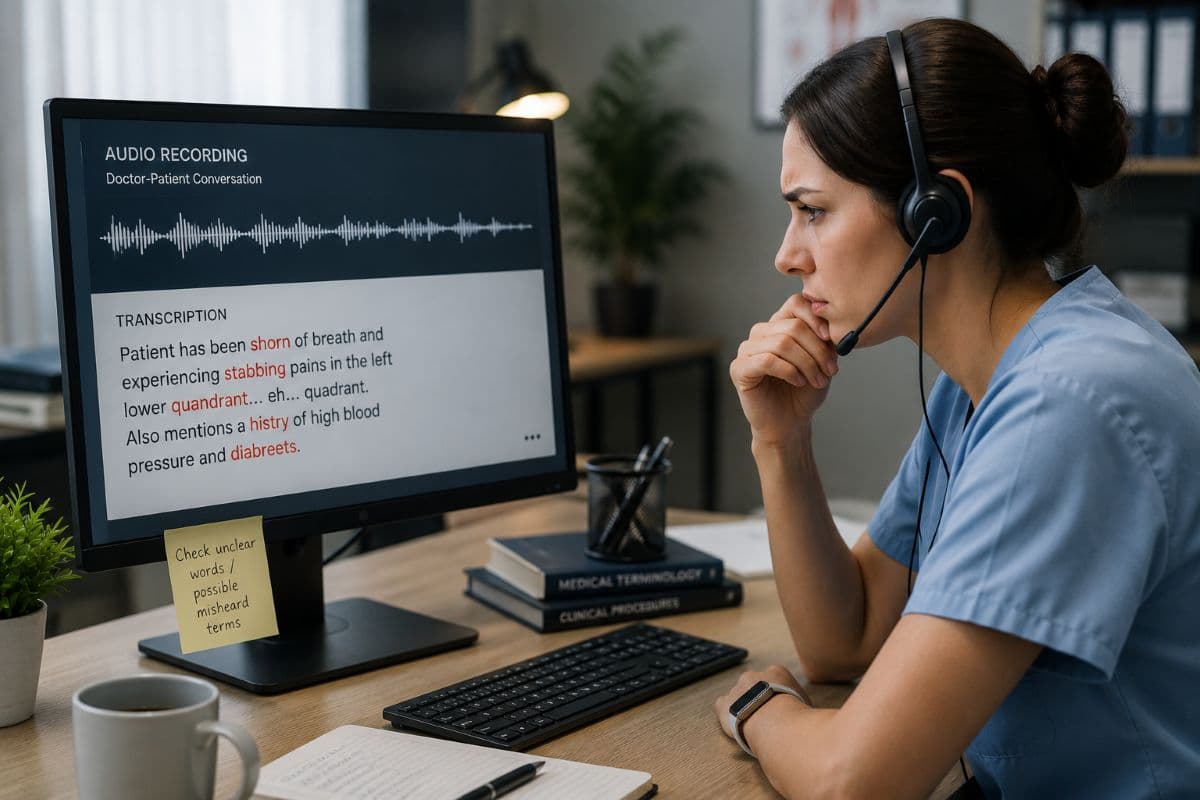
Accurate medical documentation is fundamental to patient care. Every clinical note, discharge summary, referral letter, and consultation record becomes part of a patient's medical history, informing future treatment decisions and supporting communication between healthcare professionals.
As more healthcare organizations adopt AI medical transcription, documentation is becoming faster and less reliant on manual note-taking. But no transcription system, whether human or AI, is immune to errors. Medical conversations are complex, often involving specialized terminology, multiple speakers, background noise, and fast-paced discussion. Even small mistakes can change the meaning of clinical information if they're not identified and corrected.
Understanding the most common transcription errors can help healthcare organizations improve documentation quality while getting the most from modern speech recognition technology.
Medical language presents one of the biggest challenges for transcription systems. Clinicians routinely use highly specialized vocabulary, abbreviations, drug names, and anatomical terms that sound similar but have very different meanings.
For example, confusing "ileum" with "ilium" or transcribing a medication incorrectly could create ambiguity within a patient's record. While experienced clinicians will often recognize obvious mistakes, inaccurate terminology can still slow documentation review and increase the risk of downstream errors.
This is why keyword error rate, how often specific clinical terms like drug names or diagnoses are transcribed correctly, matters more in healthcare than overall word accuracy. A model can score well on general accuracy while still missing the exact terms that carry clinical weight.
Modern AI transcription systems address this by training on healthcare-specific speech data and continuously improving their ability to recognize medical vocabulary across different specialties.
Healthcare professionals and patients come from diverse linguistic backgrounds. Conversations may involve regional accents, non-native English speakers, varying speech patterns, or differences in pronunciation that make transcription more challenging.
Speech recognition systems trained on limited datasets often experience higher error rates when encountering speakers outside those training distributions.
This is why accent diversity has become an important measure of transcription quality. Systems trained on a broader range of voices are generally better equipped to produce consistent transcripts across real-world healthcare environments.
Clinical environments are rarely quiet.
Hospital wards, emergency departments, outpatient clinics, and operating rooms all contain background conversations, medical equipment, alarms, and other environmental noise that can interfere with speech recognition.
Although modern AI models are significantly more robust than earlier generations of speech recognition software, poor audio quality can still reduce transcription accuracy.
Using appropriate microphones, minimizing unnecessary background noise where possible, and selecting transcription systems designed for real-world audio can all improve results.
Medical consultations frequently involve more than one participant. A physician may speak with a patient, family member, nurse, or interpreter during the same conversation.
Without the ability to distinguish speakers, transcripts can quickly become difficult to follow. Clinical context may be lost if statements are incorrectly attributed or presented as a single stream of text.
Many modern transcription systems support speaker diarization, which separates different speakers throughout a conversation. While diarization isn't perfect, it provides much clearer transcripts for multi-speaker clinical encounters.
A transcript without punctuation can be surprisingly difficult to interpret.
Clinical conversations often include long, complex explanations that become harder to review when presented as uninterrupted blocks of text. Poor formatting also makes it more difficult to locate diagnoses, medications, treatment plans, and follow-up instructions during later reviews.
Modern AI transcription platforms automatically add punctuation and sentence structure, producing documentation that's substantially easier to read than raw speech transcripts.
Healthcare organizations should still ensure clinicians review documentation before it's finalized, particularly for high-risk or legally significant records.
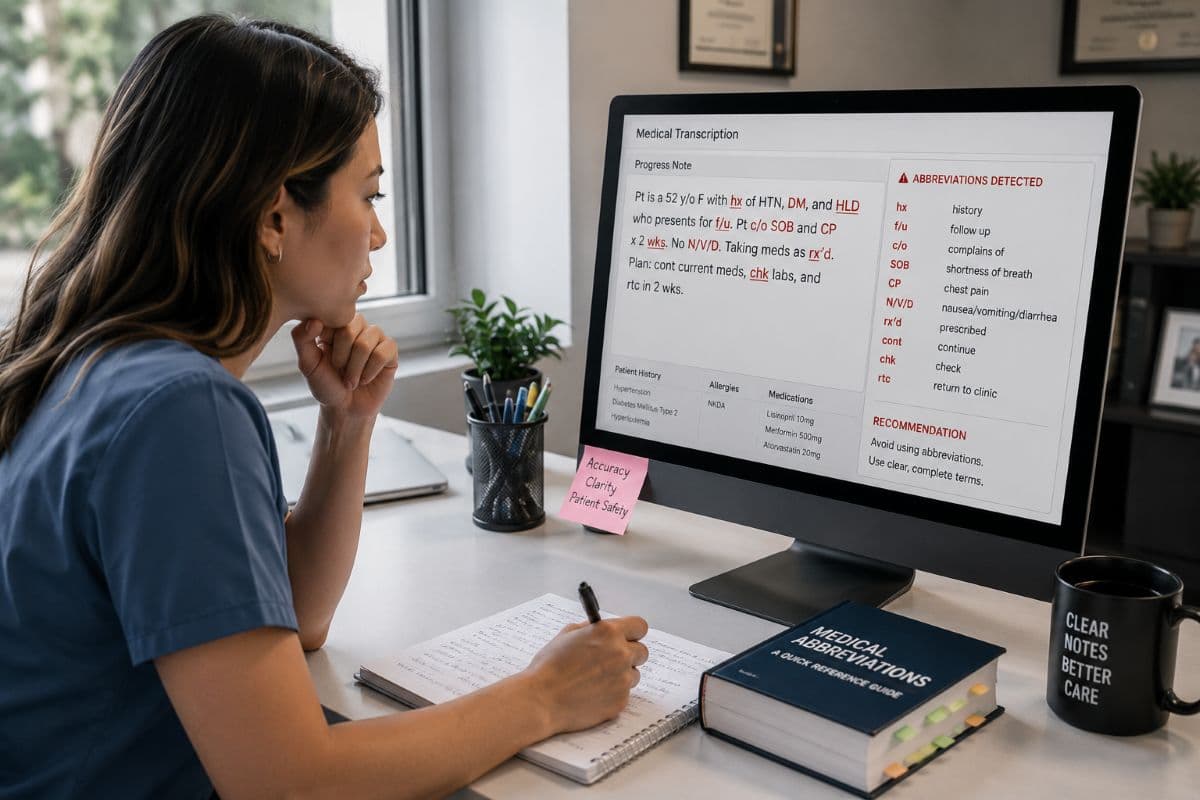
Medicine relies heavily on abbreviations, many of which have multiple meanings depending on the specialty or clinical context.
For example, "MS" could refer to multiple sclerosis, mitral stenosis, morphine sulfate, or magnesium sulfate. Human transcriptionists and AI systems alike must rely on surrounding context to determine the intended meaning.
Reducing unnecessary abbreviations during dictation and maintaining standardized documentation practices can help minimize ambiguity while improving overall transcription quality.
Speech recognition systems can only transcribe what's spoken.
When clinicians trail off mid-sentence, interrupt themselves, speak over colleagues, or use incomplete phrases, transcription naturally becomes more difficult. Similarly, if a patient mumbles or several people speak simultaneously, portions of the conversation may be difficult for any transcription system to interpret accurately.
Clear dictation, consistent microphone placement, and avoiding unnecessary interruptions all contribute to better transcription results.
AI has transformed medical transcription, but it hasn't eliminated the need for clinical oversight.
Modern speech recognition systems can dramatically reduce documentation time while producing highly accurate transcripts. However, healthcare documentation remains part of the patient's permanent medical record, making clinician review an essential part of the workflow.
Rather than replacing quality assurance, AI shifts the clinician's role from manually creating documentation to reviewing and approving transcripts. This approach is typically faster while maintaining the level of clinical accuracy required in healthcare settings.
Improving transcription accuracy isn't about relying on a single technology. It requires a combination of high-quality speech recognition, thoughtful workflows, and appropriate clinical oversight.
Organizations can reduce errors by using transcription systems trained on diverse speech data, capturing high-quality audio whenever possible, supporting speaker diarization for multi-participant conversations, and ensuring clinicians review documentation before it's finalized. Continuous monitoring also helps identify recurring issues that can be addressed through workflow improvements or model updates.
As AI models continue to improve, healthcare organizations are spending less time correcting routine transcription mistakes and more time focusing on patient care.
Advances in speech recognition are making medical transcription faster, more accurate, and better suited to the realities of clinical practice. Modern systems can recognize increasingly complex medical terminology, perform more reliably across diverse accents, and generate structured transcripts that integrate directly into healthcare workflows.
Developers and healthcare technology providers can integrate these capabilities through a medical transcription API platform, allowing AI-powered transcription to become part of electronic health record systems, clinical documentation tools, and digital health applications without building speech recognition infrastructure from scratch.
For healthcare organizations with strict data residency requirements, on-premise deployment is also an option, allowing patient audio to remain within an organization's own infrastructure rather than being processed in the cloud.
Whether you're building a clinical documentation platform, digital health application, or EHR integration, the best way to understand what's possible is to see it in practice. Book a demo to explore how our medical transcription API can fit into your workflow.




![[alt: Illustration representing multilingual code-switching for the Speechmatics Melia 1 speech-to-text model.]](/_next/image?url=https%3A%2F%2Fimages.ctfassets.net%2Fyze1aysi0225%2F2BgLftzAE6cT0uJczif4Cf%2F805533fa6d54351dddd4a4c1f1ba424e%2FMelia-codeswitching-header.webp&w=3840&q=75)
![[alt: Dark grid background with a circular symbol on the left and a pixelated "K" on the right connected by a cyan line.]](/_next/image?url=https%3A%2F%2Fimages.ctfassets.net%2Fyze1aysi0225%2F24PivVEjmscf5DwtdLPn8P%2F36637a2ef67e1e5b16a1560b3ca524b0%2FLiveKit_Inference-Social-dark.webp&w=3840&q=75)
![[alt: Three blue folders on an orange background, labeled for processing audio files of varying lengths in seconds.]](/_next/image?url=https%3A%2F%2Fimages.ctfassets.net%2Fyze1aysi0225%2F642dhRW3whpEWyQ1OimLTW%2F19aa090e4e0a35f8a0494eb0db84f864%2FMelia-TAT-Social.webp&w=3840&q=75)