
SpeechmaticsEditorial Team

Most teams do not wake up wanting to learn speech recognition.
They get handed a product problem. A PM wants voice notes. Support wants searchable call transcripts. A customer asks for captions. Someone upstairs decides the roadmap now includes an AI voice agent. Suddenly, a developer has to make speech work inside a real product, with a real deadline, and no appetite for building a research lab along the way.
That is the real shape of AI speech recognition in 2026. On paper, it sounds simple: convert speech into text. In practice, it is where a lot of otherwise sensible product ideas run into friction. The demo works. The production version stumbles. Costs get fuzzy. Accuracy drops when messy audio shows up. Security asks where the audio goes. Engineering realises that a transcript is only useful if it is fast, structured, and dependable enough to support everything built on top of it.
That is why developers should think about speech recognition as infrastructure, not a shiny feature. If the first layer is weak, every layer above it gets harder to trust.
AI speech recognition, often called automatic speech recognition or ASR, is the technology that converts spoken language into text using machine learning.
Older systems leaned heavily on fixed vocabularies, pronunciation dictionaries, and hand-built rules. They could do fine in controlled conditions, but they got brittle fast. Add background noise, overlapping speakers, strong accents, or specialist terms, and the quality dropped off.
Modern systems work differently. They are trained on large datasets of real speech, so they learn how language actually sounds across different speakers, environments, and recording conditions. That means they are better at handling natural conversation rather than neat, isolated voice commands.
This shift is what pushed speech recognition into everyday product infrastructure. It now sits underneath captioning, contact centre analytics, meeting tools, media workflows, clinical documentation, accessibility features, and voice-powered applications.
That spread across products is exactly why speech recognition has become a developer problem rather than a niche technical curiosity.
For most teams, transcription is not the destination. It is the first step in a larger workflow. The transcript may feed summarisation, search, compliance checks, note generation, sentiment analysis, or a conversational interface. If that transcript is wrong, slow, or badly structured, every downstream system inherits the mess.
This is the part teams often underestimate. They think they are adding one AI feature. What they are really adding is a stream of unstructured production data, with all the usual engineering concerns attached: latency, reliability, cost, observability, security, and failure handling.
So the real question is not whether a model can transcribe audio in a lab. It is whether the system fits the product and keeps working once real users show up.
Once that framing is clear, the mechanics start to matter in a more practical way. Most speech recognition systems follow the same path: capture audio, process it, recognise the words, then return a transcript your application can actually use.
It starts with an audio source. That could be a browser microphone, a phone call, a meeting recording, a media file, or a live stream.
Before the model transcribes anything, the system prepares the audio for recognition. It converts sound into a machine-readable representation and pulls out features that help the model identify speech patterns more efficiently. Depending on the platform, this stage may also reduce background noise, smooth out volume differences, or separate channels.
That matters because real audio is messy. Support calls include crosstalk. Meetings have echo. Mobile recordings come with weak microphones and street noise. Clinical environments bring interruptions and device sounds. A system that only performs well on clean audio is not really ready for production. It is just well-behaved in a controlled test.
Once the audio has been prepared, the model begins identifying what was said.
Modern systems use neural networks trained on speech across time, not just isolated sounds. They learn how phonetic patterns combine into words, and how those words fit together in context. That contextual layer is what helps the model choose the right word when several sound alike and produce a transcript that reads like language instead of a rough phonetic guess.
This is why training data matters so much. A model trained mostly on clean, narrow datasets may look strong in testing, then slip once users speak quickly, switch languages, interrupt each other, or use unfamiliar terminology.
Recognition is only half the job. The output has to be usable.
A plain block of text is rarely enough for enterprise workflows. Developers usually need punctuation, timestamps, confidence scores, utterance segmentation, and speaker diarisation so the transcript can be searched, reviewed, analysed, or passed into another system. In multilingual products, language identification and code-switching support also become important.
The more structure the speech layer returns cleanly, the less cleanup your application has to do later.
From there, the first practical decision is how the transcript needs to arrive.
Real-time speech recognition processes audio as it is being spoken. This is what powers live captions, call assistance, voice agents, meeting copilots, and in-call compliance capture. In these products, latency is not a side metric. If transcripts arrive too slowly, the feature stops feeling live and starts feeling broken.
Batch transcription processes completed audio files after the fact. That is common in media indexing, archive search, interview transcription, post-call analytics, and any workflow where the final transcript matters more than immediate response time. Because the model can access the full recording, batch workflows often allow richer post-processing and cleaner final output.
Most product teams end up needing both. The live experience may depend on streaming, while QA, reporting, and downstream analysis rely on asynchronous reprocessing once the session ends.
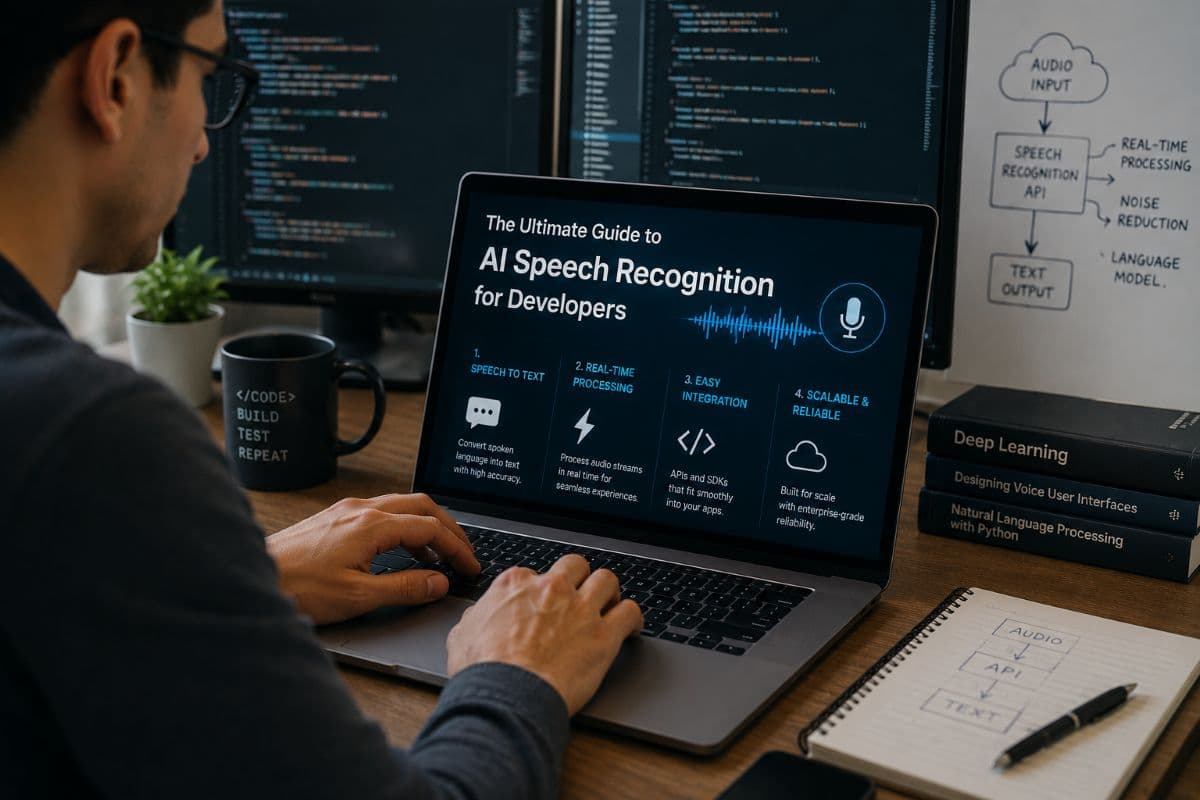
That split between live and post-session workflows brings you to the part that matters most: what happens when usage stops being tidy.
A few failure points show up again and again.
Speech recognition gets exposed quickly when training data is narrow. Users do not all sound the same. They speak with regional accents, non-native pronunciations, uneven pacing, and local vocabulary. If the model is weak here, accuracy drops in exactly the moments where users expect it to feel natural.
A lot of enterprise audio is hostile by default. Contact centre calls include interruptions. Meetings involve people speaking over each other. Mobile audio comes with inconsistent microphone quality. The gap between a model that works in a quiet sample and one that survives this kind of audio is usually the gap between prototype and production.
Generic models can struggle with product names, acronyms, specialist jargon, and industry vocabulary. In healthcare, legal, finance, and technical support, a missed term is not a cosmetic error. It can change the meaning of the transcript or make downstream automation unreliable. Custom vocabulary support and domain-tuned models matter because they reduce that cleanup at the source.
A system may feel fast in a one-user test and then degrade when concurrency climbs. That matters for anything live: captions, assistants, voice agents, compliance prompts. Developers should care about time to first token, partial transcript stability, finalisation speed, and behaviour under realistic traffic, not just a vague low-latency claim.
Even when model quality is strong, pricing can derail adoption. If you cannot explain what speech recognition costs per minute, per session, or per user, finance will eventually force the question. This gets especially messy when useful features like diarisation, multilingual support, or domain-specific models are priced as extras rather than part of the core service.
Once those common failure points are in view, evaluating providers gets much easier.
Start with accuracy, but test it on your own audio. Use samples with noise, accents, interruptions, specialist language, and weak microphones. If a vendor only looks good on polished benchmark clips, that tells you something useful.
Then look at the capabilities that determine whether the output is operationally usable:
Real-time streaming and batch transcription
Speaker diarisation
Custom vocabulary or custom dictionary support
Multilingual transcription and code-switching
Timestamps and confidence metadata
Clear SDKs and API documentation
Predictable pricing
Regional hosting and deployment options
Security controls, retention policies, and compliance posture
That mix matters because speech recognition does not live on its own. It becomes part of your product architecture. A strong platform should give you a clean way to integrate transcription without forcing your team to build around missing features or muddy governance. If you want to see how that looks in practice, Speechmatics is one example of a platform built for production use rather than just tidy demos.
By this point, the bigger pattern should be clear. Speech recognition is rarely valuable because text appears on a screen. It is valuable because the transcript unlocks something else.
Maybe that is a searchable record. Maybe it is a meeting summary. Maybe it is live agent assistance, compliance monitoring, or clinical documentation. Whatever the use case, developers should design the speech layer around what the transcript needs to do next.
That affects everything upstream: how much latency is acceptable, how much speaker separation matters, whether punctuation is enough or structured utterances are required, whether medical terminology has to be tuned from day one, and whether the data can leave a certain environment at all.
Teams that get this right usually evaluate speech recognition as infrastructure. Teams that get it wrong often treat it like a widget.
The reason speech recognition matters more now is not just that the models are better. It is that more software is becoming conversational.
Voice agents, ambient interfaces, live assistance, searchable media, and AI-generated summaries all depend on the same first layer: a transcript accurate enough to trust. If that layer is weak, everything above it becomes harder to debug, harder to explain, and harder to scale.
For developers, that makes speech recognition one of those decisions that looks narrow at the start and architectural six months later.
Choose well, and voice becomes a reliable input across your product. Choose badly, and your team inherits a stream of expensive ambiguity.




![[alt: Illustration representing multilingual code-switching for the Speechmatics Melia 1 speech-to-text model.]](/_next/image?url=https%3A%2F%2Fimages.ctfassets.net%2Fyze1aysi0225%2F2BgLftzAE6cT0uJczif4Cf%2F805533fa6d54351dddd4a4c1f1ba424e%2FMelia-codeswitching-header.webp&w=3840&q=75)
![[alt: Dark grid background with a circular symbol on the left and a pixelated "K" on the right connected by a cyan line.]](/_next/image?url=https%3A%2F%2Fimages.ctfassets.net%2Fyze1aysi0225%2F24PivVEjmscf5DwtdLPn8P%2F36637a2ef67e1e5b16a1560b3ca524b0%2FLiveKit_Inference-Social-dark.webp&w=3840&q=75)
![[alt: Three blue folders on an orange background, labeled for processing audio files of varying lengths in seconds.]](/_next/image?url=https%3A%2F%2Fimages.ctfassets.net%2Fyze1aysi0225%2F642dhRW3whpEWyQ1OimLTW%2F19aa090e4e0a35f8a0494eb0db84f864%2FMelia-TAT-Social.webp&w=3840&q=75)