Feb 20, 2018 | Read time 3 min
Speechmatics launches Global English, an accent-agnostic language pack for speech-to-text transcription
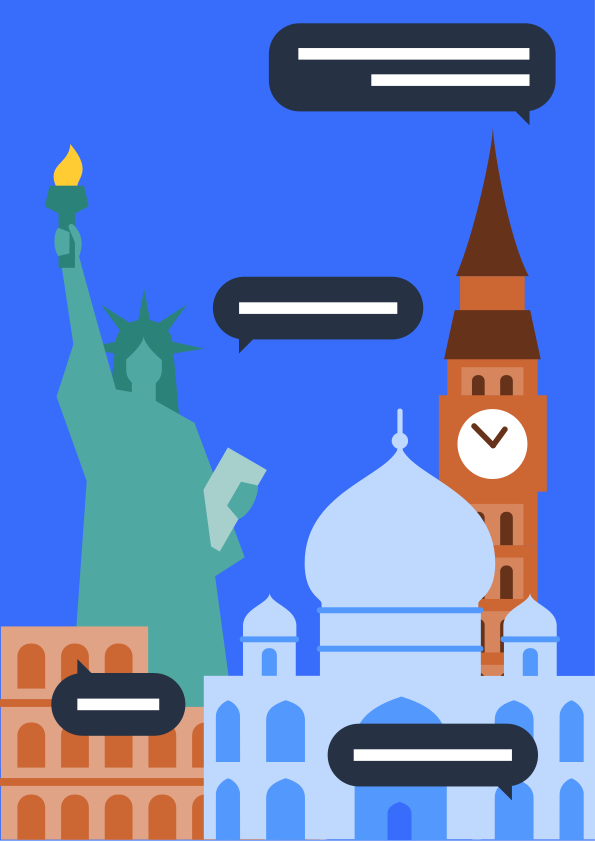
When tested against providers of similar solutions, GE consistently produced more accurate transcriptions. Compared directly, GE was between 3% and 55% more accurate than all Google’s Cloud Speech API accent-specific language packs and between 5% and 23% more accurate than IBM’s Cloud US English language pack*.
It supports every major English accent providing a consistent and cost-effective solution Today, Speechmatics is announcing the launch of Global English, a single English language pack supporting all major English accents for use in speech-to-text transcription. Global English (GE) was trained on thousands of hours of spoken data from over 40 countries and tens of billions of words drawn from global sources, making it one of the most comprehensive and accurate accent-agnostic transcription solutions on the market.
Traditionally, speech recognition has dealt with variations in language by producing a different language pack for every distinct accent or region. However, this meant a whole new set of models trained on data from that particular subset of speakers of the languages. With the launch of GE, Speechmatics is aiming to democratise speech-to-text transcription to overcome industry-wide issues where there are multiple English accents in one recording. Thus, providing a far more accurate, consistent and cost-effective solution. Speech recognition has advanced hugely in recent years, making GE possible. The team has been gathering data from a wide range of sources and taking advantage of the astonishing rise in computer power, allowing them to train bigger models, based on more data, capable of supporting more variations. Speechmatics has now built 72 unique languages, more than any other provider on the market, including Amazon, Google, Nuance, Microsoft and IBM. With the modern neural network architectures capable of generalising across variations in speech by using representation learning, Speechmatics were able to generate the accuracy of multiple specialised models all in one language pack.
Benedikt von Thüngen, CEO at Speechmatics, explained:
“At Speechmatics, we have historically produced North American, British and Australian versions of the English language packs, as well as domain-specific language packs. Applications include broadcast, compliance, speech analytics, call recording and meeting transcription among others. While a traditional British language pack does indeed perform better on British accented speech than say, a traditional North American language pack would, there’s still tens of distinct British accents to address. And so, we realised we need to come up with what we like to call ‘One Model to Rule Them All’ – an accent-agnostic language pack that is just as accurate at transcribing Australian accent as it is with Scottish.”
Tom Ash, Speech Recognition Director at Speechmatics and winner of the ‘Speech Luminary’ award, commented:
“In the UK alone, there are about 56 main ‘accent types’, and the concept of having one language pack per accent or region is very outdated. Bearing in mind that we live in an increasingly connected and mobile world, we need our tech to reflect that. We’ve all heard stories about people being misunderstood by their personal voice assistants or closed captioning getting something awkwardly wrong. While a lot of these stories are humorous, it’s ultimately highlighting a big issue. We’re hoping that Global English will inspire others to become more flexible and fair when it comes to people’s accents.”
Try it now Download infographic Download whitepaper *Test sets comprised of approximately 4 hours of diverse audio and transcribed text. Accented test files included variations in gender, age and region. We know accuracy results are always dependant on the test set used. If you would like to know further details about our test set, please get in touch.
Latest Articles

General
How Medical Transcription Supports Clinician Productivity
Discover how medical transcription improves clinician productivity by reducing documentation time, streamlining workflows, and supporting patient care.
SpeechmaticsEditorial Team
![[alt: Healthcare is a strain image]](/_next/image?url=https%3A%2F%2Fimages.ctfassets.net%2Fyze1aysi0225%2F4YLB294PotEnVZFTtksUt8%2F0f9e81fbe24027f52d1941713e032217%2Fmedical_blog_header_general_01.webp&w=3840&q=75)
Use Cases
Healthcare is feeling the strain. Multilingual AI can be the answer.
As healthcare systems face growing pressure, multilingual AI could help clinicians navigate language barriers and spend more time with patients.
Paolina WhiteSenior Director, Strategic Accounts

Technical
On-device speech-to-text, in 10 questions
Ten questions to Stuart Wood, Director of Product, on the economics of speech at scale, how close local accuracy now gets to cloud, and who could benefit from Speechmatics On-Device.
Stuart WoodDirector, Product

General
How Law Firms Can Reduce Deposition Costs with AI Transcription
Learn how law firms can reduce deposition costs with AI transcription by saving time, lowering expenses, improving efficiency, and streamlining workflows.
SpeechmaticsEditorial Team

Product
Scale more easily with Speechmatics
New ways to pay from October 1
SpeechmaticsEditorial Team
General
What Makes a Voice Agent Sound Natural?
Learn what makes voice agents sound natural, including tone, timing, speech patterns, context awareness, interruptions, and conversational responses.
SpeechmaticsEditorial Team