SpeechmaticsEditorial Team

In clinical environments, a transcription mistake is not just inconvenient. It can distort a symptom, change a medication instruction, confuse the record, or create extra work for already stretched teams.
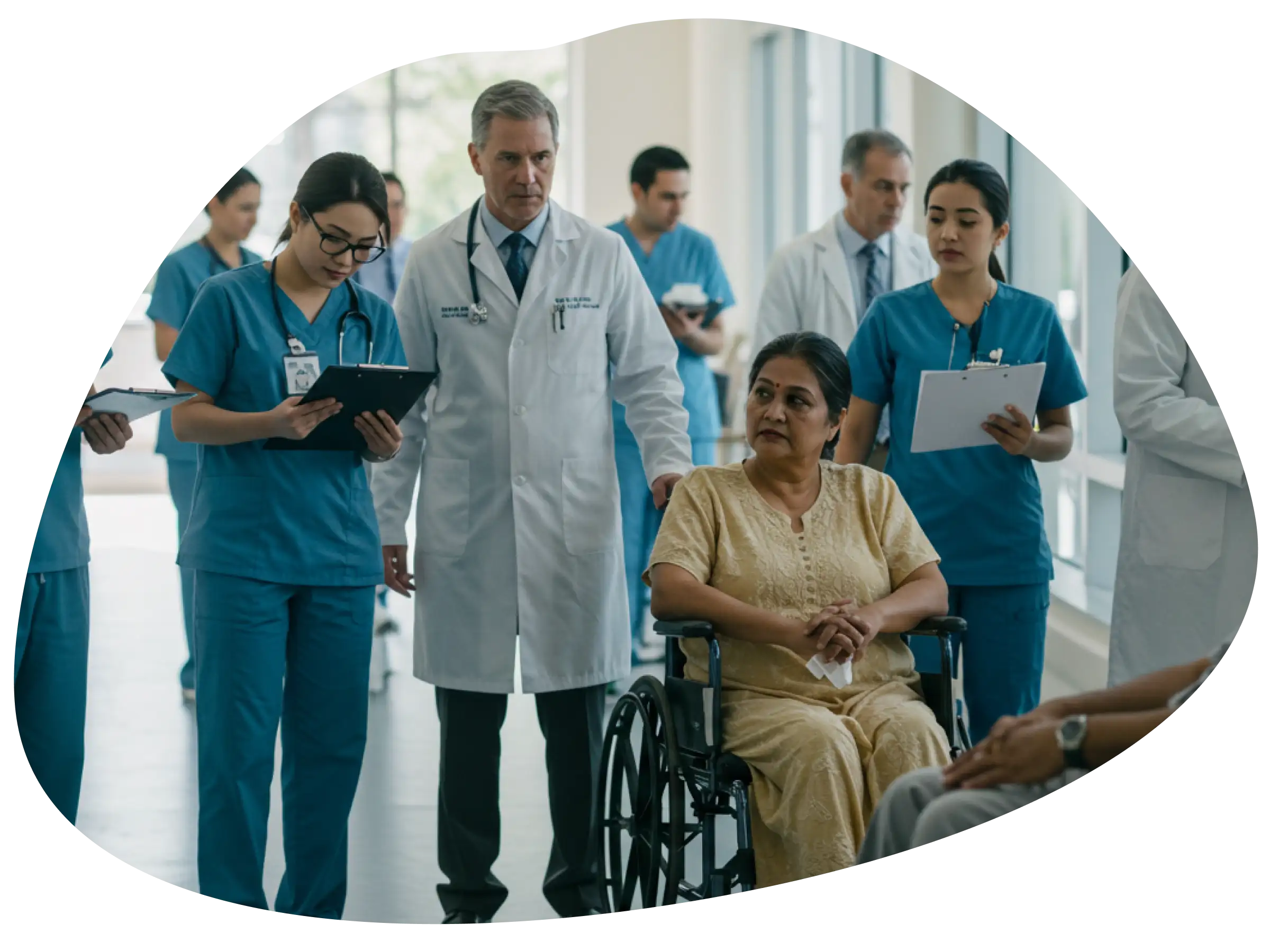
That risk gets higher when the setting is busy, the language is specialised, and more than one person is speaking at once. Emergency departments, outpatient consultations, ward rounds, telehealth appointments, and multidisciplinary case reviews all create the kind of real-world audio that exposes weak speech recognition fast.
The goal, then, is not simply to generate more transcripts. It is to reduce the kind of transcription errors that create clinical risk, slow review, and weaken trust in the system.
Healthcare is one of the least forgiving environments for speech technology.
A missed drug name, a wrong dosage, or a muddled speaker attribution can affect patient safety, documentation quality, billing, coding, compliance, and clinician confidence. Even smaller errors add up. When transcripts need heavy correction, the promised efficiency disappears and staff fall back to manual notes or dictation workflows they already distrust.
That is why accuracy in healthcare cannot be judged on clean demo audio alone. Clinical environments are full of overlapping speech, regional accents, interruptions, abbreviations, background noise, and terminology that general-purpose models often handle poorly.
The systems that work best in practice are the ones designed for real conversations, strong terminology handling, secure deployment, and reliable performance under pressure.
Before you can reduce errors, you need to understand what causes them.
In high-stakes clinical environments, problems usually come from a mix of audio conditions, workflow design, and model limitations rather than one single issue.
Clinical spaces are rarely quiet. Phones ring, monitors beep, doors open, trolleys move, and staff speak while walking or turning away from microphones.
If the input audio is weak, even a strong model starts from a disadvantage. Low-quality microphones, poor placement, room echo, and unstable network conditions in live settings all increase the chance of missed or distorted words.
Clinical speech includes specialist vocabulary that many general speech systems do not treat well.
Drug names, anatomical terms, rare conditions, acronyms, consultant names, and local service terminology can all be misheard. A model may produce text that looks fluent while getting the clinically important word wrong.
That is often more dangerous than an obviously broken transcript, because the error can slip through review.
Clinical conversations are not neat one-person monologues.
A patient may speak over a clinician. A nurse may join mid-consultation. A family member may answer on the patient’s behalf. In teaching hospitals, several voices may contribute to a discussion within seconds.
If the system cannot reliably separate speakers, the transcript may attribute statements to the wrong person or flatten the exchange into a confusing block of text.
Healthcare settings bring together people from different regions, countries, and language backgrounds. Speech can be fast, quiet, slurred by illness, shaped by distress, or interrupted by emotion.
That makes accent robustness and real-world conversational performance essential. A tool that performs well only on carefully spoken standard audio will struggle when deployed at scale.
Not every transcription problem is caused by the speech engine itself.
Sometimes the technology is placed into a workflow with no structured review, no escalation path, poor user training, or unrealistic expectations. In those cases, even decent transcripts create risk because teams do not know what has been captured, what still needs checking, or when human oversight is required.
Once those causes are clear, the solution becomes more practical. Reducing errors is usually about improving the whole chain: audio in, model choice, terminology handling, speaker separation, review workflow, and deployment controls.
Speech recognition quality is heavily shaped by the quality of the source audio.
Use microphones suited to the environment, keep them close enough to speakers where possible, and test real consultation spaces rather than quiet meeting rooms. If the use case is ambient documentation, measure performance in the exact kinds of rooms where clinicians actually work.
It is also worth testing:
Distance from speaker to device
Single-speaker versus multi-speaker capture
Background noise levels at busy times
In-person versus remote consultations
Different device types across wards or sites
A realistic audio test often reveals issues long before a formal rollout.
General-purpose transcription can be useful, but high-stakes clinical use cases usually need stronger handling of medical language.
Look for a provider that supports healthcare-specific performance, custom vocabulary, or terminology adaptation. Speechmatics positions its speech technology for real-world, privacy-critical workflows and says its medical model can cut errors on key terms by up to 50%, while also supporting speaker diarization and flexible deployment for regulated settings.
That combination matters because clinical accuracy is not only about hearing the words. It is about hearing the right words in the right context.
Even a strong medical model benefits from local tuning.
Build custom vocabulary lists for:
Medication names commonly used in your service
Consultant and clinician names
Department names
Frequently used acronyms
Place names and trust-specific terminology
Commonly referenced procedures or conditions
This is especially useful in organisations where the same specialist terms appear repeatedly. Without that support, the engine may keep making the same predictable mistakes.
In a clinical note, who said something can matter almost as much as what was said.
A patient-reported symptom, a clinician instruction, and a family observation should not collapse into one unlabelled paragraph. That creates confusion and forces manual reconstruction later.
Speech technology that includes speaker diarization is better suited to consultations, case conferences, telehealth calls, and ward discussions because it helps separate voices and preserve conversational structure.
Vendors often demonstrate performance on controlled audio. That is not enough for a healthcare buying decision.
Test with examples that reflect the hardest parts of the job:
Fast consultations
Overlapping speech
Accented speakers
Sensitive conversations spoken quietly
Noisy ward environments
Remote appointments with unstable audio
Complex terminology-heavy exchanges
Measure not just overall transcription quality, but error severity. A harmless punctuation issue is very different from a mistaken medication or an incorrect negation such as “no chest pain” becoming “chest pain”.
In high-stakes clinical environments, fully unreviewed automation is rarely the right standard.
The safer approach is usually human-in-the-loop review, especially when transcripts feed the patient record, support clinical decision-making, or shape downstream coding and compliance processes.
That review does not need to erase efficiency gains. It should focus attention where risk is highest:
Medications and dosages
Allergies
Diagnoses
Negations
Follow-up instructions
Referral decisions
Speaker attribution in disputed or complex exchanges
A transcript can accelerate documentation while still being treated as something to verify, not blindly trust.
The strongest clinical transcription workflows assume that some edge cases will fail.
That means creating clear rules for when a transcript should be flagged, corrected, escalated, or withheld from downstream use. For example, low-confidence outputs, heavy overlap, or poor audio quality may trigger a manual check before the text enters a more formal record.
This reduces the chance that questionable transcription is treated as reliable simply because it arrived quickly.
As those practical steps come together, the technology decision becomes easier to frame. In healthcare, the right platform is not the one with the best-looking demo. It is the one that holds up under clinical pressure.
Look for performance on accented speech, multi-speaker exchanges, and noisy environments rather than clean dictation alone. Speechmatics emphasises this kind of real-world transcription performance, including support for multiple speakers, accented speech, and background noise.
Clinical language handling should be visible in the product, not assumed. Healthcare teams should ask how the system manages specialist vocabulary, key-term accuracy, and custom terminology for local use cases.
Healthcare organisations often need stricter control over where data is processed and how it is handled.
Speechmatics states that it supports cloud, on-premise, and on-device deployment, does not log customer data as standard, and highlights enterprise security controls relevant to privacy-critical workflows.
For many clinical teams, those deployment options are not a bonus. They are part of the buying threshold.
Clinical procurement will usually involve information governance, security, and compliance stakeholders alongside product or engineering teams.
Speechmatics highlights ISO/IEC 27001:2022 accreditation, GDPR compliance, HIPAA compliance, and SOC 2 Type II certification on its site. That does not replace a full procurement review, but it does signal readiness for regulated environments.
Some healthcare use cases need near-live output, such as ambient documentation support, remote consultations, or accessibility workflows. In those settings, high latency creates friction even if the final transcript is accurate.
Speechmatics says its real-time speech-to-text can deliver transcription in less than one second while maintaining accuracy. For live clinical use, that kind of responsiveness can make adoption much easier.
Even good technology can disappoint when expectations are poorly set.
One common mistake is treating transcription as a simple plug-in feature rather than a workflow change. Another is buying for headline accuracy without testing speaker separation, terminology handling, or review burden.
Teams also get into trouble when they:
Rely only on demo environments
Skip frontline user testing
Ignore noisy or multi-speaker scenarios
Treat all transcription errors as equally serious
Roll out without a clear review process
Underestimate information governance requirements
Fail to track post-launch error patterns
The pattern here is simple. Most failed deployments are not caused by one dramatic flaw. They come from a series of smaller assumptions that were never tested hard enough.
By this point, the right benchmark should be clearer.
Reducing transcription errors in high-stakes clinical environments is not about chasing perfection from the engine alone. It is about building a safer system around the transcript: better audio capture, healthcare-aware modelling, terminology support, speaker separation, realistic testing, secure deployment, and structured human review.
When those pieces work together, transcription becomes more than a convenience feature. It becomes a practical tool for lowering documentation burden without lowering the standard of care.
Because the consequences are higher. An error in a healthcare transcript can affect patient records, medication instructions, follow-up decisions, coding, compliance, and clinician trust in the system.
The biggest causes are usually background noise, overlapping speakers, specialist medical terminology, accent variation, weak audio capture, and poor workflow design around review and exception handling.
It can be useful and highly effective, but high-stakes clinical use normally needs careful testing, healthcare-specific terminology handling, and human oversight for critical workflows.
Speaker diarization is the ability to distinguish between different speakers in a conversation. In healthcare, that matters because a patient, clinician, nurse, or family member may all contribute different information that should not be mixed together.
They can improve audio capture, use speech models suited to clinical language, add custom vocabulary, test on real clinical conversations, keep human review for risky outputs, and build clear rules for handling low-confidence transcripts.
Usually not for high-stakes workflows. In most clinical settings, the safer approach is to use transcription to speed up documentation while keeping appropriate human verification for critical details.
They should look for strong real-world accuracy, medical terminology support, speaker diarization, low latency where needed, secure deployment options, and compliance readiness for regulated environments.
Yes. Clinical transcription often involves sensitive patient information, so deployment flexibility, security controls, and compliance alignment are central to the decision, not secondary details.