
SpeechmaticsEditorial Team

Artificial intelligence is reshaping legal work, but efficiency alone isn't enough. Every new technology introduced into a law firm must also meet the profession's expectations around confidentiality, data protection, and client trust.
AI transcription is no exception.
The ability to automatically convert meetings, depositions, interviews, and client calls into searchable text can save lawyers significant administrative time. It also creates structured records that are easier to review, search, and analyze. But because those recordings often contain privileged or highly sensitive information, firms need confidence that adopting AI won't introduce unnecessary security or compliance risks.
The good news is that modern AI transcription doesn't have to come at the expense of client confidentiality. With the right technology and governance, law firms can improve efficiency while maintaining control over sensitive legal data.
Legal work generates an enormous volume of spoken information.
Client consultations, witness interviews, depositions, internal meetings, hearings, negotiations, and case preparation all produce conversations that eventually need to become written records. Traditionally, that process has relied on manual note-taking, human transcription services, or lawyers spending valuable billable hours documenting conversations themselves.
AI transcription changes that workflow by producing transcripts automatically, often within minutes or even in real time. Lawyers can spend less time creating documentation and more time reviewing information, preparing arguments, or advising clients.
As speech recognition technology has improved, transcription has become practical across a much broader range of legal work than was previously possible.
Despite the productivity benefits, many firms remain cautious about AI because legal professionals have an obligation to protect client information.
Every recorded conversation may include privileged communications, commercially sensitive information, personally identifiable information, or evidence relating to ongoing litigation. Uploading those recordings to the wrong service could expose confidential data or create uncertainty around where information is stored and processed.
This is why evaluating an AI transcription solution requires more than legal transcription accuracy standards, although important. Data handling practices, deployment options, security controls, and governance are equally important considerations.
One of the first questions firms should ask is what happens to recordings after they're uploaded.
Some AI services retain customer data for model training or product development. Others process audio only to generate transcripts before deleting recordings according to defined retention policies. Enterprise platforms may also provide customer-managed storage, configurable retention settings, or deployment models that allow organizations to maintain greater control over sensitive information.
Speechmatics, for example, auto-deletes audio and transcripts from its batch service after seven days by default, and does not use customer audio to train its models unless a customer explicitly opts in.
Understanding these policies is essential before introducing AI into legal workflows.
Law firms should know where data is processed, who can access it, how long it's retained, and whether it may be used for purposes beyond generating transcripts.
Cloud transcription works well for many organizations, but legal practices often have additional security requirements.
Some firms prefer private cloud deployments with dedicated infrastructure. Others require on-premises or air-gapped environments because client agreements, regulatory obligations, or government contracts prohibit sensitive information from leaving controlled networks.
Speechmatics supports this directly: on-premise deployment keeps audio within the customer's own infrastructure, with full support for air-gapped networks where no data can leave the security perimeter at all.
Deployment flexibility allows firms to choose an architecture that aligns with their own security policies rather than adapting their policies to fit the technology.
For organizations handling particularly sensitive legal matters, that flexibility can be just as important as transcription performance.
Poor transcription isn't simply an inconvenience in legal work.
Misidentified speakers, incorrect terminology, or omitted statements can create confusion when reviewing evidence or preparing case materials. Although AI transcription should never replace legal review, higher-quality transcripts reduce the amount of manual correction required while making documentation easier to search and analyze.
Legal conversations are particularly demanding because they often involve technical language, overlapping speakers, unfamiliar names, and references to legislation, contracts, or case law. Speech recognition systems designed for diverse real-world audio generally perform more reliably in these environments than systems trained primarily on clean, studio-quality recordings.
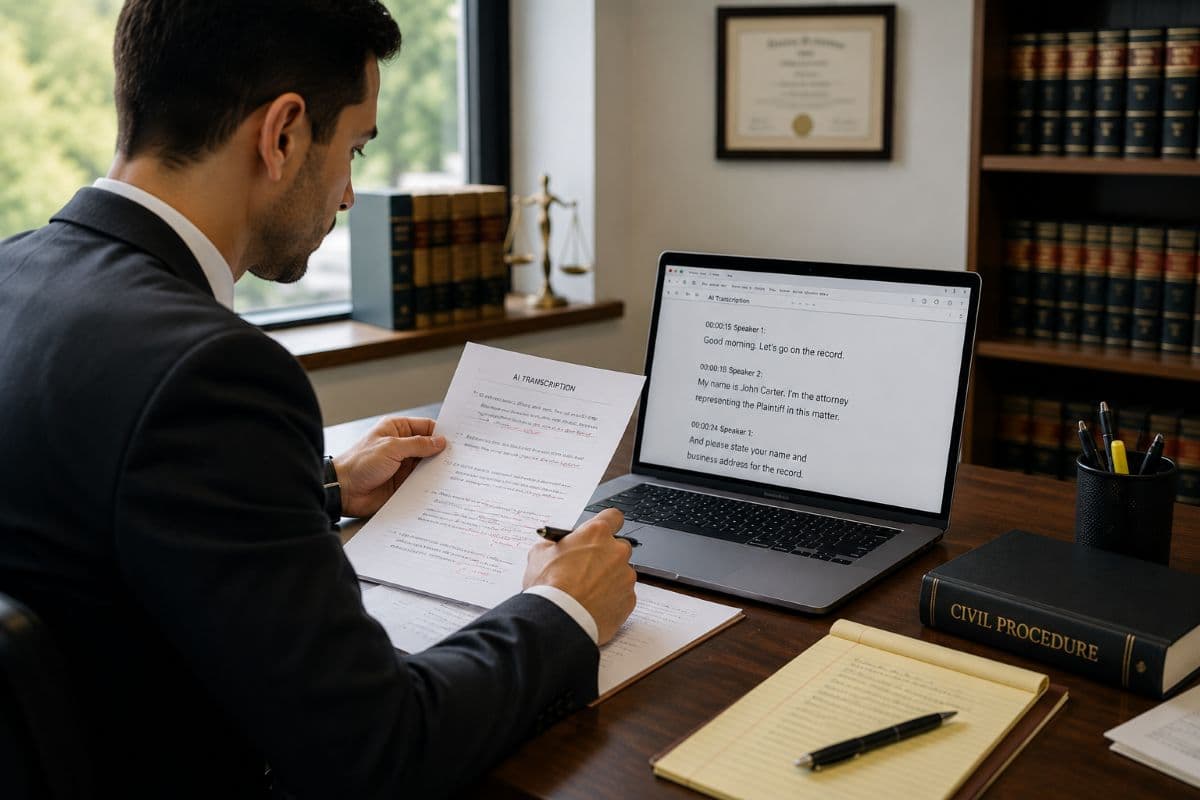
AI should support legal professionals, not replace them.
Generated transcripts should always be reviewed before becoming part of a formal legal record or being relied upon in case preparation. Lawyers remain responsible for ensuring documentation accurately reflects what was said, particularly when transcripts relate to litigation, client advice, or regulatory matters.
The most effective workflows treat AI as an assistant that accelerates documentation while keeping legal professionals firmly in control of final outputs.
Once conversations have been converted into text, they become significantly more useful.
Lawyers can search lengthy interviews in seconds, locate specific testimony without replaying recordings, summarize meetings more efficiently, and organize evidence across large collections of documents. Structured transcripts also integrate more naturally with document management systems, legal research tools, and AI-assisted review workflows.
In this sense, transcription becomes about making spoken legal information accessible in the same way written documents already are.
When evaluating technology, law firms should look beyond transcription speed alone.
Accuracy across different speakers, reliable handling of legal terminology, strong security controls, flexible deployment options, transparent data policies, and enterprise-grade governance all contribute to whether a platform is suitable for confidential legal work.
Organizations developing legal applications can also integrate speech recognition through a legal transcription AI platform, allowing secure transcription capabilities to become part of existing legal workflows without building speech recognition infrastructure internally.
The best solutions recognize that legal AI isn't simply using automation. Instead, there is a balance between enabling greater efficiency while respecting the profession's expectations around confidentiality, accuracy, and client trust.
As speech recognition technology continues to mature, AI transcription is becoming an increasingly valuable tool for modern law firms. Used appropriately, it reduces administrative workload, improves knowledge management, and makes spoken information easier to search, review, and analyze.
The technology doesn't remove the need for professional judgment or careful review. Instead, it gives legal teams faster access to accurate documentation while allowing them to maintain control over sensitive client information throughout the process.
AI transcription doesn't have to come at the expense of confidentiality. Book a demo to see how our secure speech recognition API helps legal professionals automate documentation while maintaining the privacy, accuracy, and control their clients expect.




![[alt: Illustration representing multilingual code-switching for the Speechmatics Melia 1 speech-to-text model.]](/_next/image?url=https%3A%2F%2Fimages.ctfassets.net%2Fyze1aysi0225%2F2BgLftzAE6cT0uJczif4Cf%2F805533fa6d54351dddd4a4c1f1ba424e%2FMelia-codeswitching-header.webp&w=3840&q=75)
![[alt: Dark grid background with a circular symbol on the left and a pixelated "K" on the right connected by a cyan line.]](/_next/image?url=https%3A%2F%2Fimages.ctfassets.net%2Fyze1aysi0225%2F24PivVEjmscf5DwtdLPn8P%2F36637a2ef67e1e5b16a1560b3ca524b0%2FLiveKit_Inference-Social-dark.webp&w=3840&q=75)
![[alt: Three blue folders on an orange background, labeled for processing audio files of varying lengths in seconds.]](/_next/image?url=https%3A%2F%2Fimages.ctfassets.net%2Fyze1aysi0225%2F642dhRW3whpEWyQ1OimLTW%2F19aa090e4e0a35f8a0494eb0db84f864%2FMelia-TAT-Social.webp&w=3840&q=75)