
SpeechmaticsEditorial Team
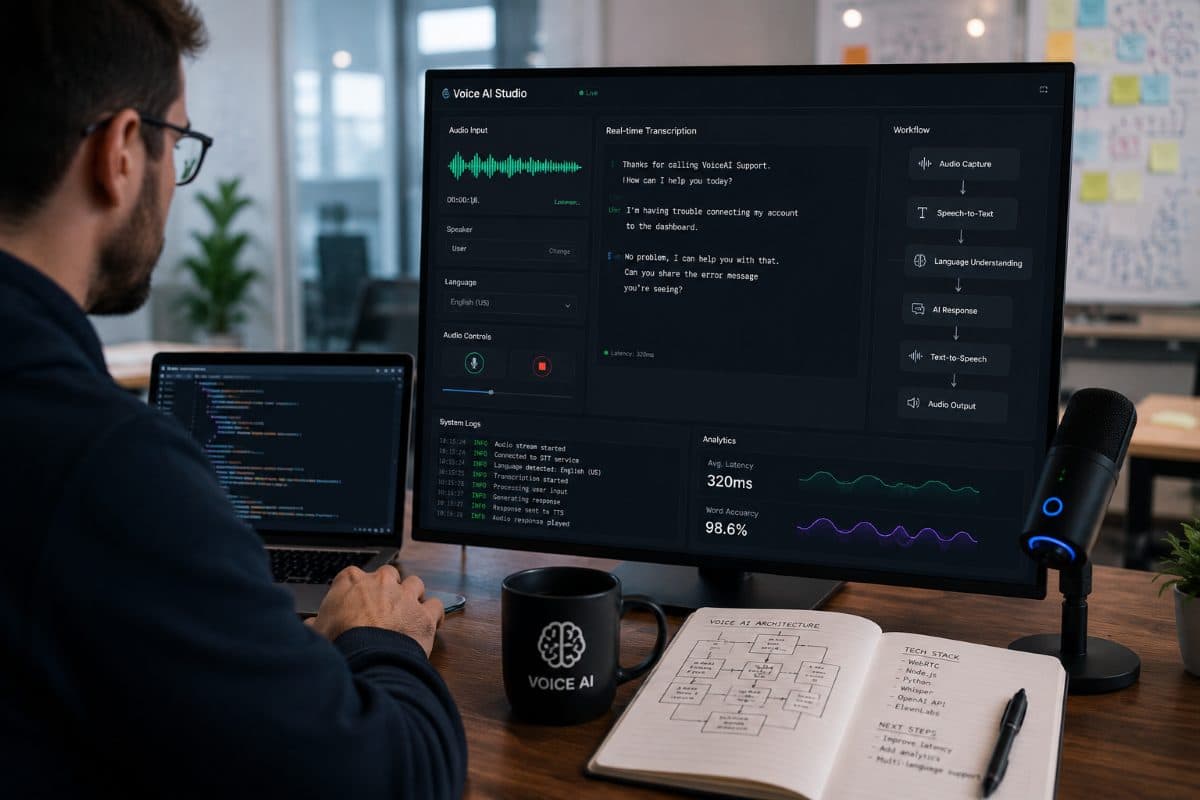
Voice AI got much easier to demo before it got easy to ship.
That is the gap most teams are still dealing with in 2026. A prototype can look convincing in an afternoon: microphone in, transcript out, language model in the loop, maybe a spoken reply on the other end. It feels like the hard part is over.
Then the real application shows up.
Users interrupt it. Audio arrives late. Someone speaks with a strong regional accent from a noisy café. The model latches onto a bad transcript and confidently goes in the wrong direction. Latency stacks up across transcription, orchestration, and response generation. What looked like a smooth voice experience in testing starts to feel brittle in production.
That is why building a serious voice AI application now starts with a less glamorous question than most product decks suggest: can your real-time transcription layer hold up once real users start talking?
If the answer is no, everything above it gets harder to trust.
A lot of teams still talk about voice AI as if the magic lives mostly in the language model. In practice, the application usually succeeds or fails one layer earlier.
Before an assistant can respond, summarize, route, guide, or act, it has to know what was said. That means turning speech into text quickly enough for the interaction to feel live, and accurately enough for the next step to be worth doing.
That first layer shapes the whole product:
If transcripts lag, the experience feels slow
If transcripts drift, the model answers the wrong thing
If speaker turns are messy, orchestration gets confused
If domain terms land badly, downstream automation becomes unreliable
If multilingual speech breaks the transcript, the product stops feeling global very quickly
So when people say they are building a voice AI app, they are usually also building a real-time speech system whether they planned to or not.
That matters because voice AI is not one product category. A support copilot, a call summarizer, a clinical assistant, a voice note tool, and a spoken interface for enterprise software may all use real-time transcription, but they do not behave the same way.
A voice agent needs low latency and stable turn-taking. A live note-taking tool can tolerate slightly slower finalization if the output is cleaner. A contact centre application may care deeply about diarisation and compliance triggers. A healthcare workflow may care more about terminology accuracy, privacy controls, and reviewability than conversational flair.
Before choosing providers or wiring together components, get specific about the workflow:
What does the user say, and what should happen next?
How quickly does the system need to respond before it feels broken?
Are partial transcripts useful, or do they create noise?
Does the application need speaker attribution?
What happens when the transcript is wrong?
Will users switch languages or accents in ways the model needs to survive?
Those questions tend to tell you more than a feature list.
At a high level, most production voice AI applications follow a familiar path.
Audio is captured from a browser, mobile device, phone system, or embedded device. That audio is streamed into a speech recognition engine. Partial and final transcripts are returned in real time. Those transcripts are then passed into an orchestration layer, often involving a language model, business logic, retrieval, tools, or workflow triggers. The system then returns a text or spoken response.
On a whiteboard, the pipeline looks manageable:
Capture speech
Stream it for transcription
Interpret the transcript
Decide what to do
Respond
The problem is that production friction appears at every step.
Microphone quality varies. Networks wobble. Users speak over the system. Partial transcripts change mid-sentence. Long pauses make turn detection messy. One slow component adds enough latency to make the whole interaction feel hesitant.
This is why teams that succeed tend to think less about “adding voice” and more about designing a real-time system that happens to use speech.
Once the live pipeline is in view, the next thing that matters is timing.
In a voice AI application, latency is not tucked away in infrastructure graphs. Users hear it. They feel it in the pauses. They notice when the system talks over them, waits too long, or answers a moment after the conversation has already moved on.
A useful way to think about latency is as a chain rather than a single number:
Time to first transcript token
Stability of partial transcript updates
Finalization delay after the speaker stops
LLM or orchestration response time
Text-to-speech generation time, if the app speaks back
Network overhead across all of the above
You can have a fast language model and still end up with a sluggish product if transcription takes too long to settle. You can also have low raw latency and still create a bad experience if partial transcripts flicker so much that downstream logic keeps changing its mind.
For voice AI, responsiveness and stability matter together.
That same pattern shows up with transcript quality.
A transcription error is not just a transcription error when the output drives something else. In a voice AI product, a missed word can become a wrong answer, a failed action, a compliance miss, or an awkward recovery turn that makes the system feel less intelligent than it sounded in the launch demo.
The cost of inaccuracy rises quickly in cases like these:
Product names and acronyms in enterprise software
Medication names and clinical shorthand in healthcare tools
Account details or policy language in support workflows
Speaker attribution in multi-party calls
Code-switching in multilingual markets
That is why teams building voice applications should care about the shape of errors, not just a generic accuracy claim. A provider that struggles with specialist terms may be worse for your product than one with slightly lower benchmark performance but better domain handling and cleaner speaker separation.
If the transcript becomes the source of truth for the rest of the interaction, the speech layer needs to be tested like production infrastructure, not admired like a benchmark result.
This is one of the less obvious design problems in live voice apps.
Real-time speech systems usually return interim text before a segment is finalized. That is essential for speed. It is also where a lot of voice products get twitchy.
If your downstream logic reacts too aggressively to unstable partials, the application can feel jumpy or confused. The model starts preparing for one intent, then the transcript changes and the turn means something else. If the UI exposes every tiny revision, users see text flicker and lose trust in the system.
A better pattern is usually to treat transcript states differently:
Use partials for anticipation, not full commitment
Use final transcripts for durable actions where possible
Buffer small revisions so the experience feels smoother
Keep the user interface clear about what is still provisional
That distinction helps the whole application behave with more confidence.
As soon as an application starts speaking back, the problem gets bigger than transcription.
Human conversation relies on turn-taking that is messy but intuitive. Voice AI has to fake that intuition using timing, silence detection, barge-in handling, interruption rules, and transcript confidence. Get it right and the interaction feels fluid. Get it wrong and the product feels either rude or dim.
This is where real-time transcription plays a second role beyond raw recognition. It helps the system decide when the user is still talking, when they have finished, and whether the response should begin now or wait a fraction longer.
That sounds small until you try it at scale. In real use, people pause mid-thought, restart sentences, interrupt the assistant, answer with fragments, and change direction halfway through a request. A system built only around neat end-of-sentence expectations starts to feel robotic very quickly.

By this point, many teams have already discovered that a voice AI product is only as global as its speech layer.
Users do not politely stay within one accent, one language, or one pronunciation pattern because your stack would prefer that they did. In many products, especially customer support, international SaaS, and mobile consumer applications, mixed-language speech and accent variation are just normal usage.
That creates several practical requirements:
Strong transcription across diverse accents
Reliable language identification where needed
Support for code-switching within the same session
Stable handling of named entities and domain vocabulary across languages
Downstream orchestration that does not fall apart when the transcript language shifts
A lot of teams discover this late because their prototype was tested on clean English. Then the first serious rollout creates a transcript quality gap between markets.
If the application is meant to work globally, multilingual and accent resilience need to be part of the first architecture pass, not a future enhancement.
That is why choosing the transcription layer is not just a procurement task. It is a product decision.
The provider you choose affects not only raw recognition, but latency, speaker handling, custom vocabulary support, deployment options, compliance posture, and how much engineering cleanup your team has to build around the transcript.
When evaluating real-time transcription for voice AI, the useful questions tend to be practical:
How fast is time to first token?
How stable are partial results?
How well does diarisation hold up in live audio?
Can the system handle domain vocabulary without awkward workarounds?
Does it support the languages and accents your users actually bring?
What observability do you get when things degrade?
How easy is it to integrate streaming into the stack you already run?
This is where platforms built for production audio start to separate themselves from providers that mainly look good in clean test conditions. If you are building for real-world voice workflows, Speechmatics is one example worth evaluating.
Even with a strong transcription engine, robust voice AI design assumes the system will occasionally mishear something.
That means the application should be able to recover gracefully instead of pretending certainty it does not have.
A few patterns help:
Confirm high-stakes actions before executing them
Use confidence signals where available
Ask targeted clarification questions rather than generic apologies
Separate low-risk conversational replies from high-risk workflow actions
Log transcript failures in a way product and engineering teams can actually inspect
This is especially important in enterprise environments. A voice feature is not just being judged on whether it sounds clever. It is being judged on whether it causes operational trouble.
The more the application can recover cleanly from uncertain speech, the more trustworthy it feels.
By now, the system is doing several things at once: capturing audio, streaming transcripts, deciding on intent, calling tools, generating responses, maybe synthesizing speech, and all of it in real time.
That makes observability non-negotiable.
If users say the system “felt slow” or “kept misunderstanding me,” you need to know where the problem lived. Was the microphone noisy? Did transcript partials churn too much? Did finalization stall? Did the LLM add the delay? Did TTS push the total response over the line where the app stopped feeling conversational?
Useful metrics often include:
Time to first token
Finalization delay
Turn completion timing
Session drop rate
Partial-to-final revision rate
Transcript accuracy on representative test sets
Speaker attribution quality where relevant
Latency by geography, device, and concurrency
Without that layer, teams end up debugging voice AI through vibes.
The more natural voice AI becomes, the easier it is to forget that it is still infrastructure handling sensitive data.
A support assistant may process customer identifiers. A healthcare workflow may capture protected health information. An internal enterprise assistant may hear commercially sensitive discussions. So the usual enterprise questions still apply:
Where does the audio go?
How long is it stored?
Is it used for model training?
What audit controls exist?
Can the system meet regional or sector-specific compliance requirements?
Do you need SaaS, private deployment, on-premise, or more restricted environments?
In practice, this is often where projects either move smoothly into production or get stuck in late-stage review.
That is the recurring thread through all of this.
Users do not care that your architecture diagram is elegant. They care that they can speak naturally and the application keeps up. They want the system to hear them properly, respond without awkward lag, recover when something goes wrong, and behave like it belongs in the workflow rather than interrupting it.
The teams that usually get there are not the ones chasing the flashiest voice demo. They are the ones treating real-time transcription as the operational layer that makes everything else possible.
In 2026, building voice AI applications still means dealing with a lot of moving parts. But the pattern is clearer now than it was a year or two ago. If the transcript is fast, stable, and trustworthy, the rest of the product has a chance. If it is not, even a strong model stack ends up sounding less capable than it really is.
That is the practical standard worth using. Not whether the app can talk, but whether it can listen well enough to be useful.




![[alt: Illustration representing multilingual code-switching for the Speechmatics Melia 1 speech-to-text model.]](/_next/image?url=https%3A%2F%2Fimages.ctfassets.net%2Fyze1aysi0225%2F2BgLftzAE6cT0uJczif4Cf%2F805533fa6d54351dddd4a4c1f1ba424e%2FMelia-codeswitching-header.webp&w=3840&q=75)
![[alt: Dark grid background with a circular symbol on the left and a pixelated "K" on the right connected by a cyan line.]](/_next/image?url=https%3A%2F%2Fimages.ctfassets.net%2Fyze1aysi0225%2F24PivVEjmscf5DwtdLPn8P%2F36637a2ef67e1e5b16a1560b3ca524b0%2FLiveKit_Inference-Social-dark.webp&w=3840&q=75)
![[alt: Three blue folders on an orange background, labeled for processing audio files of varying lengths in seconds.]](/_next/image?url=https%3A%2F%2Fimages.ctfassets.net%2Fyze1aysi0225%2F642dhRW3whpEWyQ1OimLTW%2F19aa090e4e0a35f8a0494eb0db84f864%2FMelia-TAT-Social.webp&w=3840&q=75)